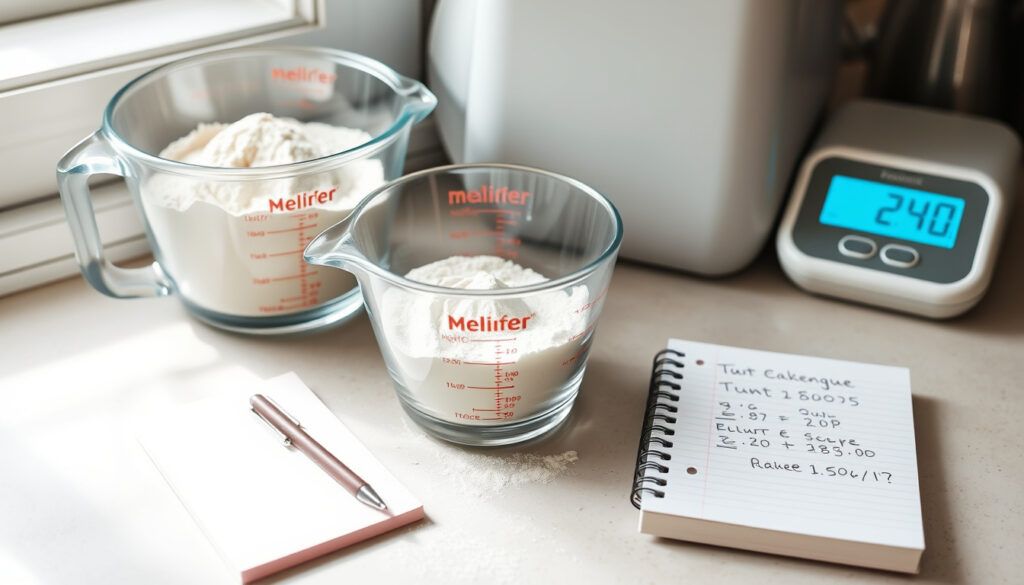
2 Cups Flour in Grams: The Exact Conversion (240g or 250g?)
If you’ve ever stared at a recipe that calls for 2 cups of flour and wondered how many grams that actually is, you’re not alone. The answer isn’t as straightforward as you might think — depending on who you ask, 2 cups of all-purpose flour weighs somewhere between 240 and 250 grams. This guide breaks down why those numbers differ and how to get consistent results every time.
2 cups all-purpose flour (most sources): 240–250g ·
1 cup all-purpose flour (King Arthur Baking): 120g ·
1 cup all-purpose flour (The Calculator Site): 125g ·
1 cup bread flour (The Calculator Site): 130g ·
2 cups bread flour (based on 130g/cup): 260g
Quick snapshot
- 2 cups all-purpose flour = 240–250g (King Arthur Baking (trusted baking authority))
- 1 cup all-purpose flour = 120–125g across major charts (Allrecipes (cooking resource))
- Exact weight depends on brand, humidity, and scooping method (King Arthur Baking (trusted baking authority))
- Whether 250g is exactly 2 cups depends on the recipe’s assumed conversion — some use 125g/cup, others 120g (King Arthur Baking; Allrecipes)
- Conversion factors remain stable — no timing changes needed for this measurement
- Consider using a kitchen scale to bypass cup-to-gram confusion entirely (King Arthur Baking (trusted baking authority))
The following table compares common conversion standards.
| Measurement | All-purpose flour | Source |
|---|---|---|
| 1 cup (King Arthur) | 120 g | King Arthur Baking (trusted baking authority) |
| 1 cup (Allrecipes / Inch Calculator) | 125 g | Allrecipes (cooking resource) |
| 1 cup (Doves Farm) | 120 g | Doves Farm (flour miller) |
| 2 cups (King Arthur) | 240 g | King Arthur Baking (trusted baking authority) |
| 2 cups (Allrecipes / Inch Calculator) | 250 g | Allrecipes (cooking resource) |
| 2 cups sifted (Doves Farm) | 220 g | Doves Farm (flour miller) |
What is 2 cups of flour in grams?
The most commonly cited range for 2 cups of all-purpose flour is 240 to 250 grams. This variation comes from how different authoritative sources define a standard cup of flour. King Arthur Baking (trusted baking authority) pegs 1 cup at 120 g, so 2 cups equal 240 g. Meanwhile, Allrecipes (cooking resource) and Inch Calculator (conversion tool) use 125 g per cup, giving 250 g for 2 cups.
Does flour type affect weight?
- Bread flour is denser: 1 cup = 130 g (The Calculator Site (conversion resource)), so 2 cups = 260 g.
- Whole wheat flour is lighter: 1 cup ≈ 113 g (King Arthur Baking (trusted baking authority)), so 2 cups ≈ 226 g.
- Cake flour is even lighter: 1 cup ≈ 114 g, making 2 cups ≈ 228 g (Weekend Bakery (baking conversion site)).
What about sifted flour?
Sifting aerates flour, reducing its weight per cup. Doves Farm (flour miller) lists unsifted all-purpose at 120 g per cup, but sifted at 110 g per cup. That means 2 cups sifted = 220 g — a full 30 g less than the unsifted 2-cup total at 240 g.
The pattern: Weight per cup moves opposite to protein content. Bread flour (high protein) is heaviest; cake flour (low protein) is lightest. Sifting further drops the number.
The pattern: the exact weight depends on the source you trust.
Is 250g flour 2 cups?
It depends on the conversion factor your recipe assumes. If a recipe defines 1 cup of flour as 125 g, then 250 g is exactly 2 cups. That’s the standard used by Inch Calculator (conversion tool) and Weekend Bakery (baking conversion site) (citing USDA data). But if it uses the 120 g/cup standard of King Arthur Baking (trusted baking authority), then 250 g is about 2.08 cups — slightly over.
Why do some recipes call for 250g = 2 cups?
Many cookbooks and online calculators round 125 g per cup for simplicity. The Calculator Site (conversion resource) uses 125 g for all-purpose, making 2 cups exactly 250 g. This convenience trade-off works for most everyday baking, but precision matters in finicky recipes like macarons or high-ratio cakes.
The catch: If you’re using a recipe that says “250 g = 2 cups,” check the original source. American baking bloggers often follow the 120 g standard; British and Australian sites lean toward 125–130 g. The difference is small but can affect hydration.
How many grams is 1 cup of flour?
One cup of all-purpose flour weighs 120 to 125 g according to the most common charts. The spread is small, but let’s look at how different types stack up:
| Flour type | 1 cup weight | 2 cups weight | Source |
|---|---|---|---|
| All-purpose (King Arthur) | 120 g | 240 g | King Arthur Baking (trusted baking authority) |
| All-purpose (Allrecipes) | 125 g | 250 g | Allrecipes (cooking resource) |
| Bread flour | 130 g | 260 g | The Calculator Site (conversion resource) |
| Whole wheat | 113 g | 226 g | King Arthur Baking (trusted baking authority) |
| Cake flour | 114 g | 228 g | Weekend Bakery (baking conversion site) |
| Self-rising flour | 120 g | 240 g | Doves Farm (flour miller) |
The trade-off: The difference per cup may seem tiny, but scaling up a recipe from 2 cups to 4 cups doubles the discrepancy. Using a scale eliminates the guesswork entirely.
How many cups is 250g of flour in a cake recipe?
Cake recipes are especially sensitive to flour weight because slight changes in hydration affect crumb structure. If your cake recipe calls for 250 g of flour, and you’re working with a cup measure, it’s safest to assume the 125 g/cup standard — that gives you exactly 2 cups. But if the recipe was developed with the 120 g/cup standard, 250 g would be roughly 2.08 cups, which could make the batter slightly drier.
Should I measure flour by volume or weight in cakes?
King Arthur Baking (trusted baking authority) strongly recommends weighing for best results. Volume measurements introduce variability: a packed cup can weigh up to 30% more than a fluffed and leveled one. For cakes, even a 10% overage can throw off the liquid balance. A digital kitchen scale removes that risk.
A cake baker who uses 250 g of flour assuming it’s exactly 2 cups, but measures by scooped cups, could end up with 300 g of flour — leading to a dry, dense cake. Weighing protects against that 20% error margin.
The catch: even a small discrepancy can affect cake texture.
How do I measure flour properly?
Getting consistent results without a scale requires the right technique. The two most common methods are spoon-and-level and scoop-and-sweep.
Spoon and level method
- Fluff the flour in its container with a spoon.
- Spoon the aerated flour into your measuring cup.
- Level off the top with a straight edge (like a knife).
This method gives the weight closest to the 120–125 g per cup range. King Arthur Baking (trusted baking authority) endorses this approach for those who don’t have a scale.
Scoop and sweep method
- Dip the measuring cup directly into the flour bin.
- Sweep off the excess with a knife.
Scooping compacts the flour, often increasing the weight by 20–30%. A cup measured this way can weigh 140–150 g, turning 2 cups into 280–300 g — far beyond the 240–250 g target.
The implication: If you scoop, you’re adding an extra 40–50 g of flour per 2 cups. For bread that can be fine; for delicate cakes it’s a disaster. Always use the spoon-and-level method or, better yet, a scale.
The implication: eliminating variability is key to consistent baking.
Confirmed facts
- 2 cups all-purpose flour = 240–250 g across major sources (King Arthur Baking, Allrecipes)
- King Arthur Baking measures 1 cup all-purpose at 120 g
- Bread flour is denser: 1 cup = 130 g (The Calculator Site)
- Sifted flour weighs ~10–15% less than unsifted (Doves Farm)
Rumors & uncertainties
- That 250 g is universally 2 cups of flour — it’s only true if the recipe uses 125 g/cup
- That scooping doesn’t change the weight — it can add 20–30% (King Arthur Baking)
- That 1 cup of flour is always the same — it varies by brand, humidity, and method
- That 1 cup all-purpose flour is always 120g – some charts, like Anna Olson’s, use 150g per cup (Anna Olson)
“We recommend weighing your ingredients with a digital scale for the best results, especially when baking.”
— King Arthur Baking (trusted baking authority)
“One cup of all-purpose flour is around 125 grams. But that number can vary depending on how you fill the cup.”
— The Calculator Site (conversion resource)
“Different flours have different weights — bread flour is heavier because of its higher protein content.”
— Allrecipes (cooking resource)
For anyone baking regularly, the gap between 240 g and 250 g for 2 cups of flour is a small but persistent puzzle. The safest path forward is clear: invest in a digital kitchen scale. It sidesteps the variability of cup measurements and ensures every recipe — whether from King Arthur or Allrecipes — comes out as intended. For the home baker who doesn’t own a scale, consistently using the spoon-and-level method with a reliable conversion (120 g per cup for all-purpose) will keep results close to the target.
industrykitchens.com.au, reddit.com, facebook.com, reddit.com
For those who prefer a metric-first approach, the nordic baking guide offers a thorough breakdown of weight variations by flour type.
Frequently asked questions
What is 2 cups of bread flour in grams?
Most sources put 1 cup of bread flour at 130 g, so 2 cups = 260 g. The Calculator Site (conversion resource) uses this figure. Allrecipes (cooking resource) lists bread flour at 136 g per cup, which would make 2 cups = 272 g. Brand-specific charts, like Janie’s Mill (flour producer), show 140 g per cup for high-protein bread flour.
What is the weight of 2 cups of cake flour?
Cake flour is lighter than all-purpose. Weekend Bakery (baking conversion site) gives cake flour at 114 g per cup, so 2 cups ≈ 228 g. King Arthur Baking (trusted baking authority) lists cake flour at 114 g per cup as well.
Does the type of flour affect the cup-to-gram conversion?
Yes, significantly. Protein content and milling density change the weight per cup. Bread flour (high protein) is heaviest at ~130 g/cup; cake flour (low protein) is lightest at ~114 g/cup. Whole wheat falls in between at ~113 g/cup (King Arthur Baking).
Why are there different numbers for the same ingredient?
Different authoritative sources use slightly different standard weights. King Arthur Baking uses 120 g/cup for all-purpose flour; Allrecipes and the USDA use 125 g/cup. These conventions reflect different measurement approaches (spoon-and-level vs. packed) and regional standards. Both are valid, but they yield different totals for 2 cups.
How do I convert 2 cups of flour to grams for a recipe using metric measurements?
If the recipe doesn’t specify, use 120 g per cup for all-purpose (King Arthur standard) or 125 g per cup (Allrecipes standard). Multiply: 2 cups × 120 g = 240 g, or 2 × 125 g = 250 g. For bread flour, use 130 g per cup; for whole wheat, 113 g per cup. The safest bet is to weigh the flour if possible.
Is 2 cups of self-rising flour the same weight as all-purpose?
Self-rising flour contains baking powder and salt but has a similar weight to all-purpose. Doves Farm (flour miller) lists self-rising at 120 g per cup, same as their all-purpose. Other sources may use 125 g per cup. So 2 cups of self-rising flour = 240–250 g.
Can I use a measuring cup for flour instead of a scale?
Yes, but consistency demands the spoon-and-level method. Scooping can add 20–30% more flour by weight. For high-precision baking (cakes, pastries), a scale is strongly recommended by King Arthur Baking (trusted baking authority) and other experts.
More related posts
 Medicube Zero Pore Pad: Usage, Safety, Results
 How Old Is Google in 2025? 27 Years Since 1998 Founding
 Fire and Ice Cafe Restaurant & Bar Menu – Hanmer Springs
 How to Fold Fitted Sheets Neatly – Step-by-Step Guide
 Unidentified Man Heathcote Valley: Police Backpack Appeal
 Craft Beer Near Me in Ireland: Guide to Local Brews
 Mortgage Rate Cuts New Zealand 2026: Forecasts & Best Deals
