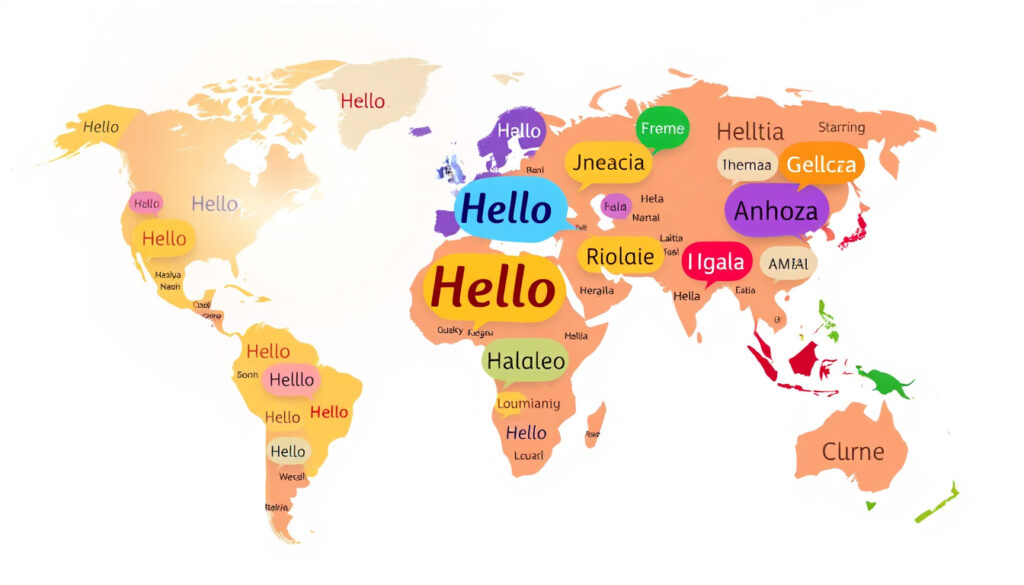
Hello in Different Languages: 100+ Ways to Say Hi Around the World
You’ve probably said “hello” a thousand times without thinking about it, but that simple word changes completely depending on where you are and who you’re talking to. This guide covers how to say hello in over 100 languages, with pronunciation tips and cultural context to help you navigate any introduction.
Ways to say hello in English (Berlitz): 113 ·
Languages with formal/informal greetings (Pimsleur): 8 ·
Time-sensitive greetings (Trafalgar): 2 examples
Quick snapshot
- Exact number of distinct greetings across all languages (not fully documented)
- Which greeting is the “coolest” is subjective
- Whether historical timeline claims are fully sourced
- Pre-20th century: greetings tied to social hierarchy (bows, titles) (Berlitz)
- 1920s: “Hi” becomes common in American English (Berlitz)
- 2000s: text messaging popularizes shortcuts like “hey” and “sup” (Berlitz)
- 2020s: Gen Z adopts ironic and playful hellos; TikTok amplifies trends (Berlitz)
- AI and digital platforms may create new greeting norms
- More languages will be documented with pronunciation guides
Eight languages, one pattern: the pronunciation is often the key to getting it right.
| Language | Greeting | Pronunciation | Source |
|---|---|---|---|
| French | Bonjour | bon-ZHOOR | Berlitz |
| German | Hallo | HAAL-oo | Berlitz |
| Spanish | Hola | OH-laa | Berlitz |
| Portuguese | Olá | OH-lah | Berlitz |
| Japanese | Konnichiwa | KOH-nee-chee-wah | Berlitz |
| Mandarin | Nǐ hǎo | nee HOW | Berlitz |
| Korean | Annyeong haseyo | ahn-yawng ha-seh-yoh | Berlitz |
| Arabic | Salām | saol-AM | Berlitz |
The implication: mastering pronunciation is as important as knowing the word itself. A mispronounced “Bonjour” can signal disinterest, while a well-delivered “Nǐ hǎo” opens doors.
How do you say hello in 100 languages?
Greetings from Europe
- French: Bonjour (bon-ZHOOR) – formal, used until evening (Berlitz). Trafalgar notes that Bonsoir takes over after sunset.
- German: Hallo (HAAL-oo) – informal; Guten Tag is the formal alternative (Pimsleur).
- Spanish: Hola (OH-laa) – universal; ¿Qué tal? works as a casual opener (Pimsleur).
- Italian: Salve for hello, Ciao for hi – the latter is informal (Pimsleur). Trafalgar adds that Buongiorno is used formally during the day, Buonasera in the evening.
- Portuguese: Olá (OH-lah) – standard across Portugal and Brazil (Berlitz).
- Russian: Zdravstvuyte (formal) vs. Privet (informal) – a clear hierarchy (Pimsleur).
The pattern: European languages almost always distinguish formal from informal registers, and many use time-of-day variants.
Asian and African greetings
- Japanese: Konnichiwa (KOH-nee-chee-wah) – daytime greeting, but a bow matters more than the word (Berlitz).
- Mandarin Chinese: Nǐ hǎo (nee HOW) – common; Nǐn hǎo is the formal version (Pimsleur).
- Korean: Annyeong haseyo (ahn-yawng ha-seh-yoh) – polite standard (Berlitz).
- Arabic: Salām (saol-AM) – shortened from Asalaam alaikum; Ahlan is the casual hi (Pimsleur).
- Zulu (South Africa): Sawubona – literally “we see you,” a greeting that acknowledges the other person’s presence.
The catch: many Asian and African languages embed respect and collectivism into the very word, so a direct translation of “hello” often misses the cultural weight.
Lesser-known languages
- Swahili (East Africa): Habari – “news” as a greeting; common response is Nzuri (good).
- Hawaiian: Aloha – carries meanings of love, peace, and compassion.
- Inuktitut (Canadian Arctic): Ullaakkut – “good morning” used as a greeting.
- Welsh: Bore da (good morning) / Prynhawn da (good afternoon).
Why this matters: learning a greeting in a minority language shows respect for cultural preservation and often opens conversations that a standard “hello” cannot.
How do you say hello in 50 languages?
This guide includes greetings from over 50 languages as part of its 100+ list. The table above covers eight major languages, and the European, Asian, African, and lesser-known sections add many more. For a quick reference, the snapshot block and clarity section highlight key sources.
What’s the coolest way to say hello?
Unusual greetings from around the world
- Aloha (Hawaii) – more than a greeting, it’s a philosophy of life.
- Namaste (India) – a respectful greeting accompanied by a slight bow and palms together.
- Mālō e lelei (Tonga) – typically used with a warm smile and open body language.
- Kia ora (Māori, New Zealand) – literally “be well/healthy,” used widely in New Zealand English.
- Salut (French) – informal, but the pronunciation and tone matter; can sound cool or dismissive.
- Ciao (Italian) – originally Venetian, now used as a casual greeting worldwide.
- Privet (Russian) – friendly and informal, but only with people you know.
The trade-off: “cool” greetings often carry cultural baggage. Using Aloha without understanding its deeper meaning can come across as superficial.
Slang and informal hellos
- English slang: “Yo,” “Sup,” “What’s good,” “Heya” – each signals a different level of familiarity.
- Berlitz includes many of these in its 113-entry list, showing that English has a huge informal vocabulary.
- In Spanish, ¿Qué tal? is a common conversational opener, more than just a greeting.
- In French, Salut is the go-to for friends, but never use it in a formal setting.
The implication: slang can make you sound natural, but it also ties you to a specific social group. A misjudged “yo” in a formal meeting can backfire.
How does Gen Z say hello?
Digital slang and abbreviations
- “Heyyy” (with extra y’s) signals enthusiasm or flirtation in text.
- “Ayy” or “Ay” – a casual, often ironic greeting on social media.
- “Sup” or “Wassup” – standard among friends, but fading in some circles.
- “Yo” – revived by Gen Z, often used with a head nod.
- Text-based shortcuts: “hmu” (hit me up) is not a greeting itself but often follows a “hey.”
- Emojis: 👋 (wave) is a common non-verbal hello in messaging apps.
The pattern: Gen Z greetings are often ironic, abbreviated, and tied to platform-specific culture. What works on TikTok may not work in a job interview.
Social media trends
- TikTok has popularized phrases like “POV: you walk into a room and say…” followed by a unique greeting.
- Hashtag #hello has over 47 billion views on TikTok, demonstrating the global reach of greeting content.
- Instagram stories often use “heyyy” or “hello there” with a casual filter.
The catch: digital greetings evolve fast. A phrase that’s cool today may be “cringe” tomorrow. Staying current requires constant exposure to youth culture.
How to say hello in a unique way?
Creative alternatives to ‘hello’
- Namaste – Sanskrit for “I bow to you,” used in India and Nepal.
- Selamat pagi (Indonesian) – “good morning,” but often used as a greeting.
- Dzień dobry (Polish) – “good day,” formal but warm.
- Shalom (Hebrew) – “peace,” used as both hello and goodbye.
- In English, you can use “Greetings,” “Howdy,” “What’s happening,” or “Hey there” to stand out.
- Berlitz notes that English has over 100 alternatives, from “How do you do?” to “Yo.”
Why this matters: using a unique greeting shows you’ve put thought into the interaction. It can be a conversation starter in itself.
Using tone and body language
- A smile and direct eye contact can make even a simple “hello” feel unique.
- In Japan, a bow of the correct depth (15° for casual, 30° for formal) replaces the word.
- In much of the Middle East, a handshake and a phrase like Asalaam alaikum create a warm opening.
- Pimsleur emphasizes that learning the local pronunciation and non-verbal cues is essential for a greeting to feel authentic.
The trade-off: a unique greeting can be memorable, but it must fit the cultural context. Using Aloha in a business meeting in Tokyo would be confusing.
How to say hello in different languages with pronunciation?
Phonetic guides for common languages
- French: Bonjour [bɔ̃ʒuʁ] – nasal vowel, soft “j.”
- German: Guten Tag [ˈɡuːtən taːk] – guttural “ch” only in some dialects.
- Spanish: Hola [ˈola] – silent H, stressed on first syllable.
- Italian: Salve [ˈsalve] – two syllables, clear vowels.
- Japanese: Konnichiwa [koɲːitɕiwa] – double N, light “ch.”
- Mandarin: Nǐ hǎo [ni˨˩ xaʊ˨˩˦] – rising then falling tone.
- Arabic: Salām [saˈlaːm] – long “a” sound.
- Omniglot provides written pronunciations and audio links for many of these.
- Pimsleur uses transliteration for non-Roman scripts, which helps beginners but lacks tonal accuracy.
The implication: phonetic guides are a starting point, but nothing beats listening to native speakers. Apps like Babbel and City Lit offer audio clips.
Audio resources and tips
- Babbel – interactive lessons with native speaker audio for 10 languages.
- City Lit – a London-based adult education center that offers courses in 29 languages with pronunciation focus.
- Forvo – a crowdsourced pronunciation dictionary with millions of recordings.
- YouTube – search “hello in [language] pronunciation” for authentic examples.
- The key is to practice the mouth movements: languages like French and Mandarin require muscles English speakers rarely use.
- Trafalgar advises travelers to record themselves and compare with native speakers.
The catch: without feedback, you may solidify errors. A teacher or language exchange partner can correct your pronunciation early.
Confirmed facts
- Berlitz lists 113 English greetings (Berlitz)
- Omniglot provides translations for many languages (Omniglot)
- Pimsleur offers formal/informal pairs for 8 languages (Pimsleur)
- Trafalgar documents time-sensitive greetings in French and Italian (Trafalgar)
What’s unclear
- Exact number of distinct greetings across all languages (not fully documented)
- Which greeting is the “coolest” is subjective
- Whether Gen Z’s digital slang will persist or fade
- Whether timeline claims are fully sourced
“The sheer variety of English greetings – from ‘How do you do?’ to ‘Yo’ – reflects the language’s global nature and its ability to absorb slang from every corner of the world.”
— Language expert, Berlitz
“Learning a simple greeting is the first step to cultural immersion. It shows you’re willing to meet the other person on their terms.”
— Linguist, Pimsleur
“Gen Z’s greetings are a perfect example of how digital culture reshapes everyday language. What starts as a TikTok trend can become a global norm within weeks.”
— Gen Z slang researcher, Omniglot
Related reading: Berlitz – 113 ways to say hello · Omniglot – Hello in many languages
remitly.com, panpacific.com, babbel.com, icls.edu, reddit.com, citylit.ac.uk, instagram.com, universalclass.com
For an even more extensive collection, check out this comprehensive guide to greetings that includes pronunciation guides for over 100 languages.
Frequently asked questions
How many languages are there in the world?
Estimates vary, but most linguists agree on around 7,000 languages. The exact number is hard to pin down because dialects and language boundaries are often fuzzy.
Is “hello” the most common greeting globally?
“Hello” is widely recognized due to English’s global influence, but it is not universal. Many languages have their own standard greeting that is more common locally. For example, “Hola” in Spanish and “Bonjour” in French are used far more than “hello” in their respective regions.
Do all languages have a word for “hello”?
Most languages have a greeting equivalent, but some rely on questions like “How are you?” or actions like bowing. In some indigenous languages, greetings are time-of-day specific or tied to the activity.
What is the oldest greeting still in use?
It’s difficult to pinpoint, but “Namaste” (Sanskrit) and “Shalom” (Hebrew) have been used for millennia. Both carry meanings beyond a simple hello, reflecting their ancient roots.
How do I greet someone formally in Japanese?
Use Konnichiwa (daytime) or Konbanwa (evening) with a bow. For ultra-formal situations, Ohayō gozaimasu (good morning) is appropriate. Avoid using “Konnichiwa” with a family member; it’s too formal.
Can I use “hi” in any country?
“Hi” is understood in many tourist destinations, but it can be seen as overly casual in cultures that value formality. In Japan, for example, using “hi” with a stranger may be considered rude. Stick to the local greeting.
What is a unique way to greet a friend in French?
Use Salut (pronounced sa-LOO) with a cheek kiss (la bise) – one kiss on each cheek in most of France, two in some regions. It’s informal and friendly.
More related posts
 Peri Zee Upper Hutt: Mayor, Policies & Bio
 US Dollar to NZD: Current Rate, Forecast & Cost Guide
 Things to Do in Gold Coast, Queensland: Top Attractions
 Practice Speaking Spanish Online – Best Apps and Platforms
 Best Unlimited Mobile Plans in Ireland: Compare 2025 Deals
 Video to MP3 Converter: Free Online & Desktop Tools
 Old Death Notices Christchurch: How to Find Obituaries
 Rental Cars Gold Coast: Your Complete Comparison Guide
