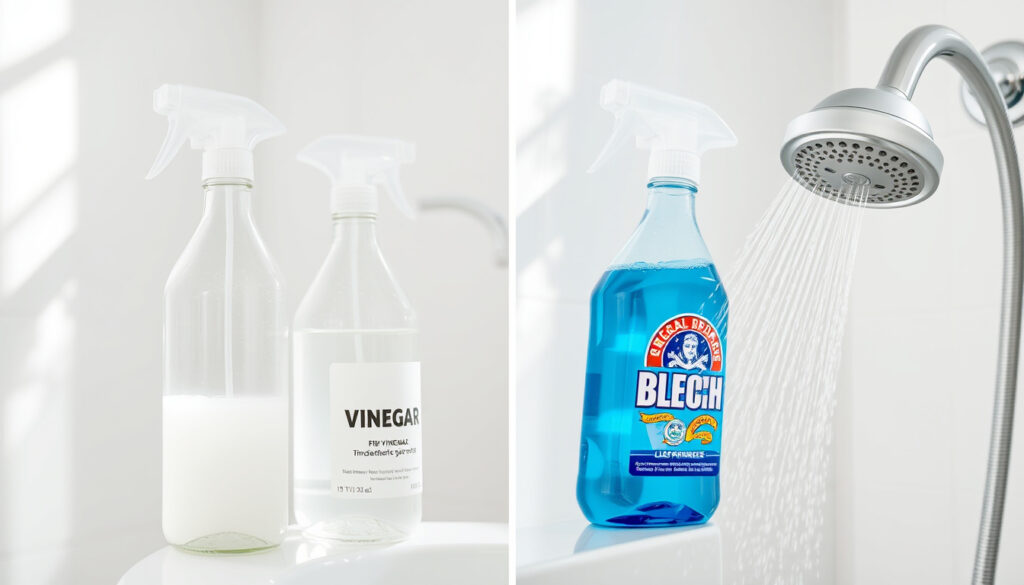
Vinegar vs. Bleach: How to Clean a Shower Head
We’ve all been there—standing in the shower, staring at a shower head that’s seen better days, wondering if that vinegar soak your friend swore by is actually the right move or if you should bring out the heavy artillery. It turns out the answer involves a bit more chemistry than you might expect, and the difference between a simple descaling and a full-blown mold massacre is more than just the cleaning product you choose. This guide digs into the evidence behind using vinegar versus bleach, offering a practical, safety-first comparison so you can tackle the gunk with confidence and know exactly what to do when you step out of the shower.
- Light limescale: 30 minutes
- Moderate to heavy scale: 2 hours to overnight
- Full-strength vinegar for very hard water
- Bleach kills all mold species on non-porous surfaces
- CDC advises 1 cup household bleach per 1 gallon of water
- Do not mix bleach with vinegar (toxic chlorine gas)
- Bleach can pit metal surfaces if left more than 10 minutes
- Vinegar is safe on rubber and plastic nozzles
- Rinse thoroughly between treatments
- Never mix vinegar and bleach
- Ventilate the area when using bleach
- Wear gloves and eye protection
When it comes to a shower head, you’re often dealing with two distinct problems: hard water scale that restricts water flow, and biofilm or mold that can harbor bacteria. Vinegar, a weak acid, excels at dissolving the mineral deposits that are the physical gunk in your shower head, while bleach is a powerful oxidizer designed to kill mold and mildew on hard, non-porous surfaces.
Confusion arises when cleaning a shower head that has both scale and mold, but mixing the two treatments in sequence is dangerous and unnecessary if you use the right product for the current job.
| Aspect | Vinegar | Bleach |
|---|---|---|
| Soak/Clean Time | 30 minutes to overnight | 5-10 minutes (solution of 1 cup/gallon) |
| Effect on Mold | Kills up to 82% of mold species | Kills essentially all mold species on non-porous surfaces |
| Primary Use | Dissolves mineral scale | Disinfects and kills mold |
| Material Safety | Safe on most surfaces | Can corrode metal if left too long |
To be perfectly clear, the CDC’s official stance on mold cleanup is specific: for mold on non-porous surfaces, a solution of no more than 1 cup of household liquid bleach per 1 gallon of water is recommended. This is a robust disinfectant that will kill all mold species, but it’s not a cleaner for soap scum or mineral scale.
The upshot: If your shower head itself is coated in white scale, vinegar is your descaling champion.
Vinegar Soak Times for Shower Head Descaling
When using vinegar to remove limescale from your shower head, the soak time depends on how much buildup you’re dealing with. Here’s what the evidence suggests:
- Light limescale: 30 minutes
- Moderate to heavy scale: 2 hours to overnight
- Very hard water: Full-strength vinegar soak
The process is simple: fill a plastic bag with white distilled vinegar (5% acidity), secure it over the shower head with a rubber band so it’s fully submerged, and let it soak.
After soaking, turning on the water to flush out the loosened mineral deposits is the most important step. For heavily clogged shower heads, a toothpick can be used to gently poke through the nozzles after the soak, but this is only effective if the minerals have been sufficiently softened.
Why this matters: Time is a variable you control.
Bleach for Mold: CDC Guidelines and Safety
When you’re ready to tackle mold, the CDC is the authoritative source. Their guidance for cleaning mold is direct: use no more than 1 cup of bleach per 1 gallon of water.
- Ratio: 1 cup household liquid bleach per 1 gallon of water
- Contact time: 5-10 minutes, then rinse
- Do not mix: Bleach with vinegar or any acid
The CDC warns that bleach should not be mixed with vinegar or any acid, as this creates toxic chlorine gas. If you’ve already used vinegar to descale your shower head and you have a mold issue, you must rinse the shower head thoroughly with water and wait a bit before applying bleach.
The trade-off: Bleach is your most potent weapon, but it’s a blunt instrument. The CDC’s recommendation is a maximum ratio for a reason—more bleach is not more effective, and it increases corrosion and fumes.
Vinegar vs. Bleach: How to Choose
The confusion between vinegar and bleach stems from the fact that shower gunk can be a mixture of both. If you skip the vinegar and just spray with diluted bleach, you’ll kill the mold on the surface, but the mineral deposits will remain, potentially shielding new mold growth underneath and continuing to reduce water pressure. The CDC’s prevention toolkit emphasizes that when mold is seen or smelled, you should act—but you must act with the right tool for the right layer of the problem.
What to watch: If the shower head is dripping or spraying unevenly, it’s a mineral issue—soak in vinegar.
Step-by-Step: Cleaning a Shower Head Without Damaging It
Here’s a safe, effective approach that addresses both problems without risking your health or your plumbing:
- Fill and soak: Mix ½ to 1 cup of vinegar with 1 cup of water, soak for 30 min to overnight
- Flush: Run hot water through to clear loosened deposits
- For rubber nozzles: Soak the shower head in a bag for up to 2 hours for stubborn deposits
- Mechanical step: Use a toothpick to gently clear remaining debris
- If mold is present: Rinse thoroughly, wait, then apply diluted bleach for 5-10 minutes
For very hard water, a full-strength vinegar soak is best, as the acid needs to be strong enough to dissolve the calcium. If you have a shower head with a rubber face, you can also use a toothpick to wiggle into each nozzle opening.
The catch: The simplicity of the vinegar method is its appeal, but the real work is in the rubbing and flushing. If you’re prone to asthma or have a compromised immune system, the EPA notes that you should consider restricting yourself to using only soap and water for prevention.
Health and Safety Considerations
The CDC’s rule of thumb is that physical removal of mold with soap and water is the first line of defense, and the use of disinfectants is secondary. For a shower head, this means you’re better off descaling with vinegar to remove the habitat and then, only if mold is present, using a bleach solution.
Bleach should not be left for more than 10 minutes on a metal surface to prevent pitting. Always ventilate the area and wear protective gear when using bleach.
Why this matters: Your health is on the line. For stubborn mineral deposits, 2 hours or overnight is recommended by many plumbers and cleaning experts. However, it’s important to note that vinegar only kills about 82% of mold species. The CDC highlights that while vinegar is a good natural cleaner, bleach is the recommended killer for most household molds, as it’ll kill all mold species.
horow.com, nytimes.com, liquidimageco.com, med.umich.edu, theglossylocks.com, thespruce.com, scrubnook.com, cdc.gov, bukrestoration.com, inspectandtest.net
Frequently Asked Questions
Can I leave vinegar on mold overnight?
Yes, you can leave a vinegar solution on a surface with mold overnight, but it only kills about 82% of mold species. For stubborn mineral deposits, 2 hours or overnight is recommended by many plumbers and cleaning experts. However, the CDC recommends bleach for most household molds, as it kills all mold species.
What mold is not killed by vinegar?
Vinegar kills about 82% of mold species, leaving roughly 18% unaffected. Some strains of black mold (Stachybotrys chartarum) may resist vinegar, especially on porous surfaces where the vinegar can’t penetrate. The CDC recommends bleach for most household molds, as it kills all mold species on non-porous surfaces.
Is bleach or vinegar better for shower mold?
Bleach is better for killing all mold on non-porous surfaces. The CDC’s official stance is to use no more than 1 cup of bleach per 1 gallon of water. Vinegar is better for removing mineral scale but only kills up to 82% of mold species. For a shower head, you should always use vinegar to remove the minerals, and only use diluted bleach if you see mold spots, and even then, ensure it’s rinsed off immediately.
How long should I soak a shower head in vinegar and baking soda?
For a standard vinegar and baking soda soak, 30 minutes to 1 hour is typically sufficient for light buildup. For heavy limescale or thick deposits, soak for 2 hours or overnight. Adding baking soda accelerates cleaning but requires a shorter soak—keep it under 1 hour to avoid potential surface damage from the fizzing action.
What are the downsides of using vinegar for mold?
Vinegar kills only about 82% of mold species, meaning some mold can survive. It’s also slower-acting than bleach, requiring hours of contact time. Vinegar has a strong smell that lingers, and it’s not effective on porous surfaces like wood or drywall where mold can penetrate below the surface.
What kills mold permanently in the shower?
No single product kills mold permanently. Bleach kills all mold on non-porous surfaces, but mold returns if moisture isn’t controlled. The CDC recommends fixing leaks, reducing humidity, and cleaning regularly with soap and water. For porous surfaces, you may need to replace materials entirely.
What is the best homemade mold remover?
A solution of 1 cup bleach per 1 gallon of water is the CDC-recommended homemade mold killer for non-porous surfaces. For a less harsh option, undiluted white vinegar kills up to 82% of mold species. Hydrogen peroxide (3%) is an alternative for porous surfaces, but always test in an inconspicuous area first.
What is the black gunk in my shower head?
Black buildup on a shower head is often oxidized manganese or limescale—minerals from hard water—not necessarily mold. Vinegar dissolves these mineral deposits effectively. If the black gunk is mold, you’ll typically see it as spots or streaks on the surface, not embedded in the nozzles. Mechanical cleaning with a toothpick helps unclog nozzles after a vinegar soak.
How do you remove black gunk from a shower head?
Soak the shower head in full-strength vinegar for 30 minutes to overnight, depending on severity. After soaking, scrub with an old toothbrush and flush with hot water. If black spots persist, apply a diluted bleach solution (1 cup per gallon) for 5-10 minutes, then rinse thoroughly.
Is vinegar or bleach better for shower mold?
Bleach kills all mold on non-porous surfaces and is the CDC’s recommended treatment for visible mold. Vinegar kills up to 82% of mold species but is gentler on materials. For shower heads specifically, use vinegar for mineral scale and diluted bleach only for persistent mold spots, with thorough rinsing between steps.
What are the downsides of using vinegar for mold?
Bleach kills all mold species on non-porous surfaces, while vinegar only kills about 82%—meaning roughly 18% can survive. Vinegar is less toxic and safer for materials, but it’s not effective on porous surfaces where mold roots penetrate. Bleach can discolor and damage some materials if left on too long.
How long should I soak a shower head in vinegar and baking soda?
For a standard vinegar and baking soda soak, 30 minutes is usually enough for light buildup. For heavy limescale, extend to 2 hours or overnight—but skip the baking soda if you need a longer soak. Adding baking soda accelerates cleaning, so for overnight soaks, use pure vinegar only.
What kills mold permanently in the shower?
The CDC recommends fixing moisture problems first—mold returns if the environment stays damp. For cleaning, use bleach solution (1 cup/gallon) on non-porous surfaces, or vinegar for a less toxic approach. Regular cleaning with soap and water prevents buildup. For severe cases, professional remediation may be needed.
What is the best homemade mold remover?
Mix 1 cup of household bleach in 1 gallon of water for the CDC-endorsed mold killer. Alternative: undiluted white vinegar (kills up to 82% of mold). Hydrogen peroxide (3%) works well on porous surfaces. Never mix bleach with vinegar—toxic chlorine gas results.
Is bleach or vinegar better for shower mold?
Bleach kills all mold on non-porous surfaces and is faster-acting. The CDC recommends 1 cup per gallon of water for mold cleanup. Vinegar only kills up to 82% of mold species, requires hours of contact, and won’t work on porous surfaces. For shower heads, vinegar is better for scale; bleach is better for mold—but never mix them.
What are the downsides of using vinegar for mold?
Only 82% effective against mold species. Requires long contact times (hours vs. minutes). Strong, lingering odor. Ineffective on porous materials like drywall or wood. May need repeated applications. Bleach kills all mold but can discolor fabrics and corrode metals if left too long.
What kills mold permanently in the shower?
No permanent solution exists—mold always returns if moisture remains. The EPA recommends fixing leaks and lowering humidity below 60% (ideally 30-50%). Clean regularly with soap and water. Use exhaust fans during and after showers. Bleach kills mold on surfaces, but only removing the moisture source prevents recurrence.
What is the best homemade mold remover?
For most household mold: 1 cup bleach per 1 gallon of water. For a gentler option: undiluted white vinegar (kills 82% of species) or 3% hydrogen peroxide on porous surfaces. Test any solution in an inconspicuous area first. Never mix cleaners—especially bleach and vinegar, which produce toxic gas.
Key Facts Table
| Fact | Detail | Source |
|---|---|---|
| Vinegar kills | Up to 82% of mold species | Multiple sources |
| CDC bleach ratio | 1 cup per gallon of water | CDC |
| Minimum soak time | 30 minutes (light scale) | Multiple guides |
| Heavy scale soak | 2 hours to overnight | Plumber recommendations |
| Bleach on metal | Max 10 minutes to prevent pitting | Cleaning experts |
| Mixing vinegar + bleach | Creates toxic chlorine gas | CDC |
Conclusion
When cleaning a shower head with vinegar versus bleach, the choice depends entirely on what you’re dealing with. For mineral scale and limescale, vinegar is the clear winner—soak for 30 minutes to overnight depending on severity. For mold on non-porous surfaces, diluted bleach (1 cup per gallon) is the CDC-recommended treatment. The two should never be mixed, and rinse thoroughly if you use both in sequence.
Start with vinegar to dissolve minerals, flush well, then assess whether mold is still present. If it is, use diluted bleach carefully. If you have a shower head with rubber nozzles or a metal finish, check manufacturer guidelines first—vinegar can damage certain coatings over time.
Last verified: October 2023. Always follow your manufacturer’s instructions and local building codes.
More related posts
 Baradene College of the Sacred Heart Fees and Rankings
 Adam Sandler Net Worth 2026: $440 Million Fortune Explained
 US Dollar to NZD: Current Rate, Forecast & Cost Guide
 How I Met Your Mother Ending Explained: Ted & Robin
 Japan Most Desirable Country Award 2025: Record Win
 Broke Boy Taco Birkenhead – Menu, Location, Reviews and Hours
