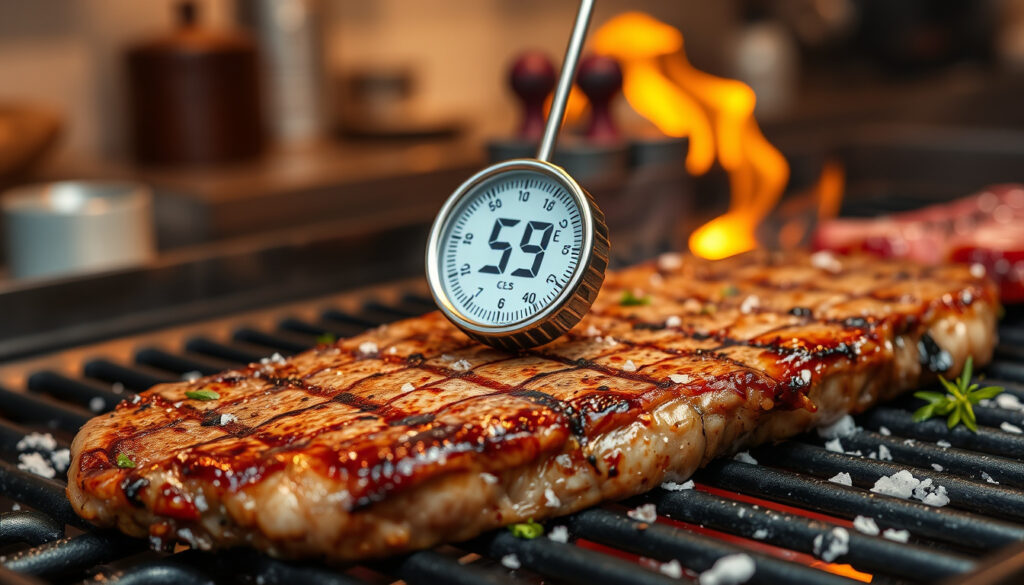
Medium Rare Steak Temp in Celsius: 52-54°C Guide
Anyone who has pulled a steak off the heat only to cut into a gray slab instead of the warm red center they were hoping for knows cooking steak is more about temperature than timing. The difference between a good steak and a perfect one often comes down to a matter of degrees — about 52–54°C on the thermometer at pull time, and this guide will help you hit that sweet spot consistently by focusing on precision, not guesswork.
Medium rare target temperature: 52–54°C (130–135°F) ·
Ideal steak thickness for 3-3-3 rule: 1 inch (2.5 cm) ·
Recommended resting time: 5 minutes ·
Carryover cooking rise: 2–3°C
Quick snapshot
- Medium rare internal temperature is 54–57°C (130–135°F) final; pull at 52–54°C (ThermoWorks – temperature guide)
- Carryover cooking raises internal temp by 2–3°C after removal (Steak School – doneness chart)
- Rest steak 5 minutes before slicing to retain juices (Clover Meadows Beef – resting guide)
- The exact origin of the 3-3-3 rule for steak is not documented in any published source
- Optimal steak flipping frequency (single vs. multiple flips) is debated among professional chefs
- Internal temperature continues to rise 2–3°C over 3–5 minutes after steak leaves heat (The Perfect Steak – pull temperature chart)
- Resting period of 5 min is part of the total cook timeline (Clover Meadows Beef – resting guide)
- Verify doneness with a probe thermometer inserted into the thickest part (My Heavenly Recipes – thermometer placement)
- Slice against the grain after resting for maximum tenderness (My Heavenly Recipes – thermometer placement)
Key facts below present the essential numbers for perfect medium-rare.
| Fact | Value |
|---|---|
| Carryover cooking | Internal temperature rises 2–3°C after removing from heat. |
| Resting time | Rest steak for 5 minutes before slicing to retain juices. |
| Ideal thickness | 1 inch (2.5 cm) balances sear and doneness. |
| Thermometer placement | Insert into the thickest part, avoiding bone or fat. |
What is the 3-3-3 rule for steak?
How to apply the 3-3-3 rule
- The 3-3-3 rule means 3 minutes on one side, 3 minutes on the other, and 3 minutes resting or final heat management (The MeatStick – 3-3-3 method explained).
- It works best as a searing guideline, not a precision doneness standard.
Thickness and cut requirements
- The rule is designed for a 1-inch thick steak; thicker cuts require adjusted timing or oven finishing.
- Uniform thickness helps ensure even cooking (Grilling24x7 – rule of threes).
Limitations of the rule
- Does not guarantee precise doneness because heat intensity, pan material, and starting steak temperature vary.
- Always use a thermometer to confirm internal temperature (Meatman – pull temperature guide).
The implication: if you rely solely on time, you risk missing the precise temperature target.
How many C is a medium steak?
Medium steak temperature range
- Medium doneness: 58–60°C (136–140°F) final internal temperature (Elements Smokehouse – Celsius guide).
- At this stage the center is pink and warm, with less juice than medium-rare.
Difference between medium and medium-rare
- Medium-rare: 54–57°C (130–135°F) final; pull at 52–54°C to account for carryover (Meatman – pull temperature guide).
- Medium: 58–60°C; the center loses redness and becomes firmer.
How to measure internal temperature
- Use a probe thermometer inserted into the thickest part, avoiding bone or fat (Secret Society Recipes – placement tips).
- For best accuracy, insert from the side to reach the geometric center.
The catch: even a slight overshoot changes the entire eating experience.
How long do you cook a steak for medium rare?
Cooking times by thickness (pan-searing)
- For a 1-inch (2.5 cm) steak, pan-sear 3–4 minutes per side on high heat (BBC Good Food – pan-fry times).
- For a 2-inch steak, sear 5–6 minutes per side, then finish in a 180°C oven for 10–12 minutes.
Cooking times by thickness (grilling)
- Grill a 1-inch steak over direct high heat for 4–5 minutes per side for medium-rare (Clover Meadows Beef – grilling guide).
- Thicker steaks benefit from reverse-sear: slow bake at 130°C until internal reaches 50°C, then sear.
Factors that affect time
- Heat level, cut (ribeye vs. sirloin cooks differently), and starting steak temperature all influence cooking time.
- Always verify with a thermometer; time is only an estimate.
What this means: treat time as a starting point, not a final verdict.
Is 50°C medium rare?
What 50°C steak looks like
- At 50°C (122°F) the center is bright red, cool, and the texture is very soft – that is rare, not medium-rare (Australian Meadow Meats – doneness descriptions).
- Rare steak reaches 48–52°C final temperature.
Why 50°C is considered rare
- Medium-rare starts at 52°C (125°F) and goes to 57°C (135°F). At 50°C, the meat has not undergone enough protein denaturation to achieve the warm red center that defines medium-rare.
Correct medium-rare range
- Pull temperature: 52–54°C; final temperature after resting: 54–57°C (Elements Smokehouse – Celsius guide).
The pattern: every degree counts when aiming for that 52°C pull point.
Do I put steak 3 minutes on each side?
Adjusting time for thickness and heat
- 3 minutes per side on a hot pan yields medium-rare for a 1-inch steak – but only if the pan is sufficiently hot (200°C+ surface temp).
- Thicker steaks need more time per side or a two-zone cooking method.
Testing doneness without a thermometer
- The finger-test (comparing steak firmness to the fleshy part of your palm) gives a rough estimate but is unreliable for beginners (Clover Meadows Beef – touch test).
- For consistent results, a thermometer removes guesswork.
Why 3 minutes per side works for 1-inch steaks
- At high heat, 3 minutes per side brings the interior of a 1-inch steak to approximately 52–54°C – the ideal pull temperature for medium-rare (BBC Good Food – timing guide).
- Beyond that thickness, 3 minutes per side undercooks the center or over-sears the outside.
The catch: pan temperature and steak thickness must be precise for the rule to work.
How to cook a medium rare steak step by step
- Take the steak out of the fridge 30 minutes before cooking to bring it to room temperature (about 20°C).
- Pat dry with paper towels and season generously with salt and pepper just before cooking.
- Heat a heavy pan (cast iron or stainless steel) over high heat until it smokes, then add a high smoke-point oil (avocado or canola).
- Place steak in the pan and cook 3–4 minutes per side for a 1-inch steak, flipping only once.
- Insert a probe thermometer into the thickest part. For medium-rare, pull the steak at 52°C (125°F).
- Transfer to a cutting board and rest for 5 minutes undisturbed. The temperature will rise to 54–57°C (130–135°F).
- Slice against the grain and serve immediately.
For thicker steaks (1.5–2 inches), use the reverse-sear method: bake at 130°C until internal reads 48°C, then sear on high heat 1–2 minutes per side.
What we know and what remains unclear
Confirmed facts
- Medium-rare internal temperature is 54–57°C (130–135°F) per multiple authoritative sources (ThermoWorks – temperature guide).
- Carryover cooking adds 2–3°C to the final temperature (Steak School – carryover explanation).
What’s unclear
- The exact origin of the 3-3-3 rule is not documented.
- Optimal steak flipping frequency (single vs. multiple flips) is debated among chefs.
- The 3-3-3 rule as a popular guideline for 1-inch steaks lacks definitive culinary authority.
What this reveals: even well-known rules have gaps that only accurate measurement can bridge.
Expert perspectives on medium rare steak
Medium rare steak is 130–135°F (54–57°C).
— ThermoWorks blog, Steak Temps guide
Medium rare is 52°C / 125°F to 54°C / 130°F.
— Steak School, Temperature chart
Medium rare is 55–60°C (130–140°F).
— Wikipedia, Doneness article
Pan-fry a 2cm thick steak for 2–3 minutes each side for medium-rare.
— BBC Good Food, Perfect steak tips
The temperature ranges cited across sources vary by a few degrees, but the consensus is clear: medium-rare lives in a 4–5°C window. The difference between rare and medium-rare is just 2–3°C – small enough that a minute too long on the heat can push you past the target. For home cooks in the US who often work in Fahrenheit, remembering 52°C as the pull temperature simplifies the process. The implication: invest in a reliable thermometer; your steak will thank you.
For a more detailed breakdown of the science behind the perfect doneness, check out this medium rare steak temperature guide that explains why 54°C is the sweet spot for tenderness and flavor.
Frequently asked questions
What is the best cut of steak for medium rare?
Well-marbled cuts like ribeye, NY strip, and filet mignon are excellent. Ribeye offers more fat for juiciness, while filet is leaner and more tender.
Should you salt steak before cooking for medium rare?
Yes, salting at least 30 minutes before cooking (or up to 24 hours in advance) helps the seasoning penetrate the meat. Pat dry just before searing.
How do you rest a steak after cooking?
Place the steak on a cutting board or wire rack and let it rest 5 minutes. Do not wrap it – tenting traps steam and can overcook the outer layers.
What is carryover cooking and how does it affect doneness?
Carryover cooking is the continued internal temperature rise after removing the steak from heat. For a 1-inch steak, expect a 2–3°C increase. Pull the steak at 52°C if you want final 54–55°C.
Can you cook a medium rare steak in an air fryer?
Yes. Preheat to 200°C, cook a 1-inch steak for 8–10 minutes flipping halfway, then check internal temp. Air fryers can cook evenly but may not produce a heavy crust; finish with a quick sear in a pan if desired.
How do you know when steak is medium rare without a thermometer?
The finger test: press the fleshy part of your palm below the thumb when thumb touches index finger – that firmness equals medium-rare. But it takes practice; a thermometer is far more reliable.
What is the reverse sear method for medium rare steak?
Cook the steak in a low oven (130°C) until internal temperature reaches 48–50°C, then finish in a hot pan for 1–2 minutes per side. This technique gives a perfect crust without overcooking the interior.
More related posts
 Camera House Lower Hutt – Address, Hours, Services & Reviews
 Second Hand Cars Auckland: Cheap Used Under $10k Guide
 How to Cook Brussel Sprouts – Crispy Methods and Times
 Flood Situation Near Waikato River: Live Updates & Maps
 159 USD to NZD: Convert & Understand the Rate
 Range Rover for Sale NZ – 2025 Prices, Models & Deals
 NZ Dollars to Euros: Live Rate, Conversion & Forecast
 Best Winter Running Gear 2025: Expert Picks for Women, Men & UK
