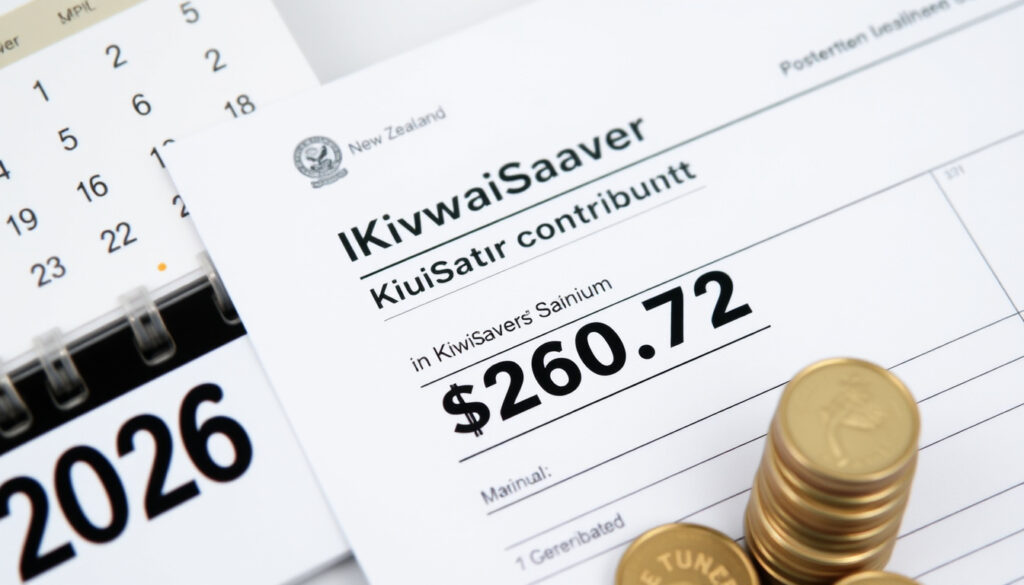
Government Contribution to KiwiSaver: $260.72 Max & 2026 Changes
Few questions about KiwiSaver cause as much confusion as the government contribution. It’s not a $1,000 lump sum anymore – the maximum annual credit is $260.72, earned at 25 cents per dollar up to a limit, with rules shifting in 2025 and more changes in 2026.
Maximum annual government contribution: $260.72 ·
Contribution rate: 25 cents per dollar ·
Minimum personal contribution for full amount: $1,042.86 ·
Eligibility age: 16 to 65 (from July 2025)
Quick snapshot
- Maximum annual credit: $260.72 (New Zealand Inland Revenue (IRD))
- Rate: 25c per $1 of personal contributions (IRD)
- You must contribute at least $1,042.86 per year (ANZ)
- Eligibility age: 16 to 65, living mainly in New Zealand (IRD)
- Whether the contribution amount will increase in future years (no official schedule) (IRD notes residency requirement)
- Exact overseas eligibility rules for temporary residents (IRD notes residency requirement)
- How the general 4% withdrawal rule applies to KiwiSaver specifically (it’s a guideline, not a rule) (IRD notes residency requirement)
- The eligibility of temporary residents in specific circumstances (IRD notes residency requirement)
- The future of the contribution amount after 2028 (IRD notes residency requirement)
- 1 July 2025: Eligibility expanded to 16‑17 year‑olds; income cap of $180,000 introduced (IRD)
- 1 April 2026: Minimum employee/employer contribution rises to 3.5% (Generate Wealth)
- 1 April 2028: Minimum contribution rises further to 4% (Enable)
- Phased increase in minimum contribution rates over 2026–2028 (Enable)
- Employer contributions for 16‑17 year‑olds become compulsory from April 2026 (Lockton Global)
- Potential for further changes if government reviews the scheme again (Enable)
Five key figures sum up the government contribution to KiwiSaver in one table:
| Detail | Value |
|---|---|
| Maximum annual contribution | $260.72 (IRD) |
| Contribution rate | 25c per $1 (IRD) |
| Minimum personal contribution | $1,042.86 (ANZ) |
| Eligibility age | 16 to 65 (from July 2025) (IRD) |
| Income cap (new from July 2025) | $180,000 annual taxable income (IRD) |
| Current minimum employee contribution | 3% (IRD) |
| From 1 April 2026 minimum employee contribution | 3.5% (Generate Wealth) |
| From 1 April 2028 minimum employee contribution | 4% (Enable) |
What is the KiwiSaver Government Contribution?
Does the government still give $1000 for KiwiSaver?
- No. The old $1,000 lump sum was replaced years ago with a member tax credit.
- Today the government matches 25c for every $1 you contribute, up to a maximum of $260.72 per year (IRD).
- The $1,000 figure is outdated; many sources still reference it, but it no longer applies.
How much is the maximum annual contribution?
- The maximum government contribution is $260.72 per year (IRD).
- To get the full amount, you must personally contribute at least $1,042.86 between 1 July and 30 June (ANZ).
- Only voluntary contributions and salary deductions count – employer contributions and past government credits do not (IRD).
How is the contribution calculated?
- The government pays 25 cents for every dollar you contribute, up to a maximum of $1,042.86 in personal contributions.
- Calculation: $1,042.86 × 0.25 = $260.72.
- The credit is paid after the end of the contribution year, usually around September (IRD).
The old $1,000 lump sum is history. New savers should budget for $1,042.86 in annual contributions to capture the full $260.72 – that’s roughly $20 per week.
The implication: consistent, modest contributions earn a guaranteed return from the government, but only if you meet the thresholds.
Do you get the government contribution to KiwiSaver?
Who is eligible for the KiwiSaver government contribution?
- You must be aged 16 to 65 (from July 2025, previously 18–65) (IRD).
- You must be “mainly living in New Zealand” (IRD).
- You must make contributions – either through salary deductions or voluntary payments.
- Self‑employed and part‑time workers are eligible as long as they contribute.
What age does government contribution to KiwiSaver start?
- The minimum age is 16, effective from 1 July 2025 (IRD).
- Individuals under 16 can join KiwiSaver but do not receive the government contribution.
- Before July 2025, the minimum age was 18.
KiwiSaver government contribution after 65: does it apply?
- No. Once you turn 65, you stop being eligible for the government contribution (IRD).
- If you have not started withdrawing, you can still hold a KiwiSaver account, but no further credits are added.
The pattern: age and residency are the gatekeepers; missing either means no government top‑up.
Is the KiwiSaver going to 4% minimum?
What are the current KiwiSaver contribution rates?
- Current minimum employee contribution: 3% of salary (Generate Wealth).
- Current minimum employer contribution: 3% of salary (IRD).
- Employees can choose to contribute at a higher rate (4%, 6%, 8%, or 10%).
What changes are happening from 1 April 2026?
- From 1 April 2026, the minimum employee contribution rises to 3.5%, and the employer minimum also goes to 3.5% (Generate Wealth).
- From 1 April 2028, both rates increase again to 4% (Enable).
- Employers must also start contributing for workers aged 16–17 from April 2026 (Lockton Global).
How does the 4% minimum affect government contribution?
- The government contribution is unaffected by the minimum rate changes – it remains a separate credit based on personal contributions.
- Higher employee contributions mean you reach the $1,042.86 threshold faster, but the government match is capped at $260.72 regardless.
- Employer contributions are not matched by the government.
If you’re already contributing more than the minimum, the rate change won’t affect your government credit. But lower‑paid earners on the default 3% will automatically save more from 2026.
The catch: the government contribution stays flat while your own savings rate climbs – a small but steady bonus.
What happens to KiwiSaver if I move overseas?
Can I still receive the government contribution while living overseas?
- No, unless you are on specific overseas service (e.g., defence, diplomatic) (IRD).
- The “mainly living in New Zealand” rule means you lose eligibility once you permanently move abroad.
How long can I stay overseas before my KiwiSaver is affected?
- There is no set grace period for the government contribution – it stops immediately when you stop living mainly in NZ.
- For withdrawal purposes, you can apply to withdraw your KiwiSaver after being overseas for one year (IRD).
What if I move overseas permanently?
- You can apply to withdraw your KiwiSaver balance (including the government contributions you already received) after one year of permanent absence.
- If you leave permanently before age 65, you forfeit any future government contributions.
- The rules are complex – check IRD guidance before moving (IRD).
The pattern: emigration severs the government match entirely; only existing credits stay.
What is the 4% rule on KiwiSaver?
What is the 25x rule for retirement?
- The 25x rule says you need 25 times your annual expenses saved to retire comfortably.
- It’s derived from the 4% rule: if you withdraw 4% each year, you need 25× that amount.
- These are guidelines, not official KiwiSaver rules.
How do the 4% and 25x rules relate to KiwiSaver?
- KiwiSaver is a savings vehicle; the 4% rule can help estimate how much you need to accumulate in your account.
- For example, if you need $40,000 per year, you would aim for $1 million in KiwiSaver (25×).
- The government contribution adds up to $260.72 annually, which helps, but it’s a small part of the total.
Are these rules official or guidelines?
- They are guidelines, not regulations. The 4% rule was developed from the William Bengen study of historical returns (Enable references retirement planning).
- New Zealanders using KiwiSaver may still want to consult these rules when planning, but they are not part of KiwiSaver policy.
The takeaway: these rules are benchmarks, not policies – your government match is independent of them.
What age does government contribution to KiwiSaver start?
What is the minimum age to receive the government contribution?
- 16, since 1 July 2025 (IRD).
- Before July 2025, the minimum was 18.
Can I get the contribution before age 18?
- Yes, if you are 16 or 17 from July 2025 onwards.
- If you joined KiwiSaver before turning 16, you can start receiving the contribution once you turn 16 (provided you are contributing).
Does the contribution stop at age 65?
- Yes. The government contribution ends at age 65 (IRD).
- You can keep your KiwiSaver account and withdraw from it, but no further credits are added.
What this means: younger workers now have a longer runway to capture the match.
How to maximize your government contribution
- Contribute at least $1,042.86 per year – this captures the full $260.72 credit. That’s about $20 per week. (IRD)
- Ensure you are eligible – check your age (16–65) and that you are mainly living in New Zealand.
- Make voluntary contributions if you are self‑employed or not working – you can still contribute directly to your KiwiSaver account.
- Avoid missing a year – if you stop contributing, you lose the credit for that year. It does not roll over.
- Watch the income cap – if your taxable income is above $180,000, you are not eligible from July 2025 (IRD).
Savers should treat this as a guaranteed 25% return on their contribution – a rare free boost.
Timeline of KiwiSaver government contribution changes
- – KiwiSaver launched; government contribution introduced as a $1,000 lump sum (IRD).
- – Lump sum replaced by member tax credit of up to $521.43 (50c per $1) (IRD).
- – Maximum reduced to $260.72 (25c per $1) (IRD).
- – Eligibility expanded to ages 16–17; income cap of $180,000 introduced (IRD).
- – Minimum contribution rate rises to 3.5% for employees and employers (Generate Wealth).
- – Minimum contribution rate rises to 4% (Enable).
The pattern: the government’s role has transformed from seed capital to a small but steady annual bonus.
What we know vs what’s unclear
Confirmed facts
- Maximum government contribution is $260.72 per year (IRD).
- Eligibility age is 16–65 from July 2025 (IRD).
- Minimum contribution to get full amount is $1,042.86 (ANZ).
- Rate changes on 1 April 2026 (3.5%) and 1 April 2028 (4%) are confirmed (Generate Wealth).
- New income cap of $180,000 from July 2025 (IRD).
What’s unclear
- Whether the government contribution amount will increase in future.
- How the 4% rule applies to KiwiSaver specifically (it’s a general guideline).
- Exact overseas eligibility rules for temporary residents.
- The eligibility of temporary residents in specific circumstances.
- The future of the contribution amount after 2028.
Perspectives from the industry
The maximum annual government contribution is $260.72, paid at a rate of 25 cents for every dollar you contribute.
New Zealand Inland Revenue (regulator)
To receive the full government contribution, you need to contribute at least $1,042.86 each year.
ANZ (major KiwiSaver provider)
From 1 April 2026, the minimum employee contribution will rise to 3.5% as part of the phased increase to 4% by 2028.
For New Zealanders planning their retirement, the choice is clear: if you contribute at least $1,042.86 per year, the government adds $260.72. The upcoming rate hikes mean you’ll automatically save more from 2026, but the credit itself won’t change. Anyone in the 16–65 age range living in New Zealand should treat the $260.72 as a guaranteed return on a modest annual contribution – and make sure they don’t leave it on the table.
mercerfinancialservices.co.nz, superlife.co.nz, simplicity.kiwi, mortgagelab.co.nz
To make the most of the government contribution, it’s important to also understand the 2026 minimum rate increase and how it affects your total savings.
Frequently asked questions
Can I get the government contribution if I am self‑employed?
Yes, as long as you make voluntary contributions to your KiwiSaver account and meet the age and residency requirements.
What if I stop contributing for a year?
You will not receive the government contribution for that year. It does not roll over or accumulate.
Does employer contribution count toward the government contribution?
No, only your personal contributions (salary deductions or voluntary payments) count. Employer contributions are not matched.
Is the government contribution taxable?
No, the government contribution (member tax credit) is not taxable income. It is added directly to your KiwiSaver account.
Can I have multiple KiwiSaver accounts?
You can only have one KiwiSaver account at a time. If you change providers, your account moves, not duplicates.
When is the government contribution paid into my account?
It is usually paid after the end of the contribution year (1 July – 30 June), and typically appears by September.
How do I check my government contribution?
You can check your KiwiSaver account online through your provider’s portal or through myIR from Inland Revenue.
What happens if I change KiwiSaver providers?
Your account balance and the government contribution follow you. The transfer does not affect your eligibility or the credit.
More related posts
 Cast of Avengers: Doomsday: Confirmed Actors & Rumors
 Translate Spanish to English: Free, Accurate, Real-Time Guide
 Flood Situation Near Waikato River: Live Updates & Maps
 What Is the Longest Word in the World? 45 vs 189,819 Letters
 Best Unlimited Mobile Plans in Ireland: Compare 2025 Deals
 Mineral Resources Share Price ASX – Live Price News Forecast
 Most Expensive LEGO Set 2025: Death Star 75419 Facts
