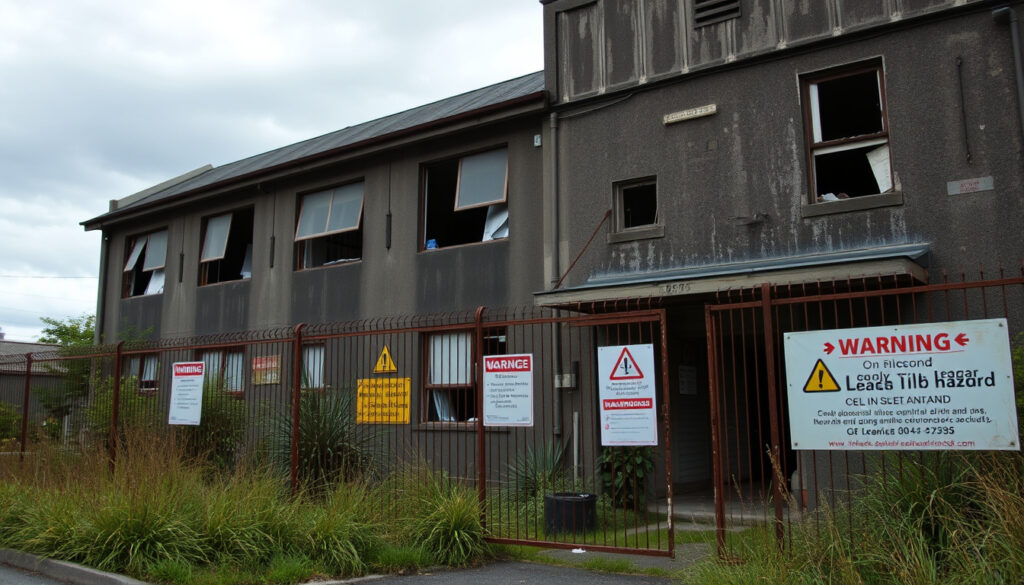
Auckland Abandoned Building Concerns: Legal & Safety Risks
Take a walk through parts of Auckland and you might spot a building that looks frozen in time — windows boarded, weeds pushing through cracks, a quiet air of neglect. These aren’t just eyesores; they sit at a messy crossroads of property law, safety risks, and community anxiety. This article unpacks the legal gray zones, the real-world dangers, and what you can actually do about abandoned buildings in Auckland in 2025.
Empty dwellings in New Zealand (2023 census): 100,000 ·
Highly burgled neighbourhoods identified in Auckland: 10 ·
News articles covering Auckland abandoned building concerns (Jan 2025): NZ Herald, The Spinoff
Quick snapshot
- 100,000 empty dwellings nationwide per 2023 census (RNZ (national public broadcaster))
- Adverse possession requires 20 years of continuous occupation (Convex Legal (NZ property law firm))
- Trespass notices can ban a squatter for 2 years (New Zealand Police (national law enforcement))
- Exact number of abandoned buildings just in Auckland
- Number of squatters currently occupying abandoned buildings in the city
- Specific legal penalties for leaving a building empty in New Zealand
- 2023: Census records 100,000 empty dwellings across NZ (NZ Herald (major NZ daily))
- Jan 2025: NZ Herald covers Auckland’s abandoned buildings and squatter fears (NZ Herald (major NZ daily))
- Nov 2025: The Spinoff publishes a tour of Auckland Central’s empty buildings (NZ Herald (major NZ daily))
- Growing public pressure for clearer penalties on empty properties
- Potential council action on high-risk derelict sites
- Increased public awareness via news coverage and community reporting
The table below summarises the key facts about abandoned buildings in Auckland.
| Fact | Detail | Source |
|---|---|---|
| Empty dwellings in New Zealand | 100,000 (2023 census) | RNZ |
| Year of most recent census | 2023 | Stats NZ (national statistics agency) |
| Auckland abandoned build news coverage | NZ Herald, The Spinoff (2025) | NZ Herald, The Spinoff |
| Report abandoned building to | Auckland Council | Auckland Council (local government) |
Can you claim an abandoned house in NZ?
What is adverse possession?
- Adverse possession is the legal doctrine sometimes called “squatter’s rights.” In New Zealand, it allows someone who occupies land continuously and without permission to eventually apply for legal ownership after 20 years (Convex Legal).
- It does not apply to Crown land, Māori land, land owned by a local authority, or land held in trust for public purposes (Convex Legal).
One claim, one major exception: twenty years of occupation is the bar, and most Auckland abandoned buildings don’t qualify because the land is often owned by private developers or the council.
How long must you occupy an abandoned property to claim it?
The rule is strict: continuous possession must last at least 20 years, and the occupant must be fairly visible — secret or intermittent occupation does not count (Convex Legal). After that, the Registrar General of Land can cancel the existing title and issue a new one (Rainey Collins (NZ law firm)).
The pattern: 20 years is a generational commitment. For most squatters in Auckland’s abandoned buildings, this is a theoretical right, not a practical one.
Squatters’ rights in New Zealand
Property owners have the fundamental right to exclude others from their land in New Zealand (Lawlink (NZ legal advice firm)). The Residential Tenancies Act 1986 gives the Tenancy Tribunal jurisdiction to order possession even when there is no tenancy agreement (New Zealand Legislation — Residential Tenancies Act 1986 (official statute)). Police guidance confirms that a trespass notice can bar someone from returning for two years (New Zealand Police).
The implication: squatters have very limited rights in practice. The legal system is stacked toward the property owner, and the 20-year adverse possession rule is a high bar that few can meet.
The pattern: while the law offers a path to ownership, the practical barriers make it unlikely for most squatters.
How many abandoned houses are there in New Zealand?
What does the 2023 census say about empty dwellings?
- The 2023 census recorded 100,000 empty dwellings across New Zealand — properties that are unoccupied, often referred to as “ghost houses” (RNZ).
- This figure covers the entire country, not just Auckland. The exact number of abandoned buildings specifically in Auckland is not officially tracked.
One number, one gap: 100,000 empty homes nationally, but no official count just for Auckland. That matters because local concerns need local data.
Why are so many properties left empty?
New Zealand has no penalties for leaving buildings empty, according to reporting by The Spinoff (NZ culture and news outlet). Developers sometimes pause projects mid-construction due to financial issues or market shifts, leaving shells behind. Other properties sit empty because of ownership disputes, estate delays, or simply because owners have no incentive to sell or maintain them.
The catch: no penalty means no urgency. An empty building can sit for years while neighbors watch it decay.
New Zealand has a housing shortage and 100,000 empty dwellings at the same time. The gap between policy and reality is a concrete wall — no tax, no fine, no requirement to maintain or sell.
What this means: the lack of penalties allows properties to sit empty indefinitely, exacerbating the housing crisis.
What are the rough areas in Auckland?
Top 10 most burgled Auckland neighbourhoods
- Burglary rates vary across Auckland suburbs, with certain neighbourhoods identified as higher risk. Specific lists of the most burgled areas are available from local police data and news reports.
- Abandoned buildings can contribute to local crime by attracting squatters, vandals, and providing cover for illegal activity.
10 neighbourhoods, one warning: areas with more abandoned or poorly maintained properties tend to see higher crime rates. The connection is not always causal, but the correlation is strong.
What is the safest suburb to live in Auckland?
Safety rankings shift year to year, but suburbs with lower burglary rates, better street lighting, and active community patrols consistently rank higher. Auckland Council publishes crime statistics and safety resources for residents. For the latest rankings, check official police data for your specific suburb.
Why this matters: knowing the risk profile of your neighbourhood helps you decide whether to report that abandoned building next door — or pressure the council for action.
Is it illegal to explore abandoned locations?
What happens if you explore an abandoned house?
- Trespassing laws apply in New Zealand — entering a property without permission is illegal (New Zealand Police).
- Risks include injury from unstable structures, fines, and potential criminal charges if items are taken or damage is caused.
- In 2025, a Reddit post reported a section of concrete formwork collapsing from a third story at an abandoned development behind Farro Fresh Greenlane (Reddit r/auckland (community discussion)).
One collapse, many rules: exploring abandoned buildings is not just illegal — it can be physically dangerous.
8 Rules for Exploring Abandoned Places
The urban exploration (urbex) community promotes guidelines to minimize risk and legal trouble: never trespass on clearly posted property, never force entry, take nothing but photos, leave nothing but footprints, and always prioritize personal safety. The meaning of “urbex” — urban exploration — is the hobby of visiting abandoned or off-limits urban locations. But in New Zealand, the law treats it as trespass, and the consequences can include a criminal record.
Urbex enthusiasts in Auckland face a real legal trade-off: the thrill of discovery versus the risk of fines, injury, or a police record. The Greenlane collapse shows that even experienced explorers can be caught off guard by structural dangers.
The implication: urbex enthusiasts must weigh the risks of legal consequences and physical harm.
What is the meaning of the word urbex?
Urbex is short for urban exploration — the practice of visiting abandoned, derelict, or otherwise off-limits built environments. While the community often appeals to curiosity and documentation, New Zealand law does not carve out an exception for hobbyists. Whether you’re taking photos or just looking, entering without permission is trespassing.
Does Auckland have a homeless problem?
Homelessness in Auckland statistics
- Auckland has a significant homeless population, with estimates varying but consistently in the thousands. Official figures and shelter data point to an ongoing crisis.
- Abandoned buildings often attract individuals experiencing homelessness, who may use them for shelter despite the safety and legal risks.
One connection that is hard to ignore: empty buildings become de facto shelters when there are not enough housing options. The problem is cyclical — lack of housing leads to squatters, which leads to complaints, which leads to more abandoned buildings.
Connection between abandoned buildings and homelessness
The Auckland Council provides resources for reporting abandoned buildings and for supporting homeless individuals. Residents who see squatters in a derelict property can call 111 if there is an immediate safety risk, or report the building through the council’s “Report a problem” page (Auckland Council).
Why this matters: the link between abandoned buildings and homelessness is a policy failure that affects both property owners and vulnerable people. Reporting is the first step, but systemic solutions require more than individual action.
For Auckland Council, every abandoned building is a choice: enforce maintenance, demolish, or leave it empty. For the homeless, it is a choice between a dangerous shelter and no shelter at all. For residents, it is a choice between reporting and waiting for something to go wrong.
Confirmed facts
- 100,000 empty dwellings in NZ (2023 census) — RNZ
- Auckland Council has a “Report a problem” page for abandoned buildings — Auckland Council
- Adverse possession requires 20 years continuous occupation — Convex Legal
- Trespass notices can ban a squatter for 2 years — New Zealand Police
- No penalties for leaving buildings empty in NZ — The Spinoff
- Concrete formwork collapse at Greenlane abandoned development — Reddit r/auckland
What’s unclear
- Exact number of abandoned buildings specifically in Auckland
- Number of squatters currently occupying abandoned buildings in Auckland
- Specific legal penalties for property abandonment in NZ
- Whether developers face any consequences for pausing projects mid-construction
Timeline of key events
- 2023 — New Zealand census reports 100,000 empty dwellings across the country (RNZ)
- 2025-01-06 — NZ Herald publishes article on Auckland’s abandoned buildings sparking fears over squatters and vandalism (NZ Herald)
- 2025-11-22 — The Spinoff publishes “A mystery tour of Auckland Central’s empty(ish) buildings” (The Spinoff)
- 2025 (undated) — Reddit post reports collapse of concrete formwork at abandoned development behind Farro Fresh Greenlane (Reddit r/auckland)
The pattern: from national data to local incidents, the timeline shows a growing public and media focus on abandoned buildings in Auckland — but no policy change yet.
“An air of mystery surrounds the developments, with many living nearby worrying about squatters, vandalism…”
— Journalist, NZ Herald (major NZ daily)
“A section of concrete formwork collapse from a 3rd story.”
— Reddit user, Reddit r/auckland (community discussion)
“New Zealand has no penalties for empty buildings.”
— Writer, The Spinoff (NZ culture and news outlet)
For Auckland residents, the choice is clear: report the abandoned building next door, advocate for clearer penalties, or wait for the next collapse. For policymakers, the gap between 100,000 empty homes and a housing crisis is a gap that needs closing — with rules, not just reports.
policepolicy.nz, convexlegal.co.nz, reddit.com, reddit.com, nzpropertyinvestor.co.nz
Frequently asked questions
How can I report an abandoned building in Auckland?
Use the Auckland Council “Report a problem” page at aucklandcouncil.govt.nz. For immediate safety risks, call 111.
What should I do if I see squatters in an abandoned building?
Do not approach them directly. If there is an immediate safety risk, call 111. Otherwise, report the building to Auckland Council. The police can enforce trespass orders if the property owner files one.
Are abandoned buildings dangerous?
Yes. Risks include structural collapse, exposed wiring, hazardous materials, and potential criminal activity. The Greenlane formwork collapse in 2025 is a recent example.
Who owns abandoned buildings in Auckland?
Ownership varies — private developers, individual landowners, or the council. Many are tied up in financial disputes or estate delays. The exact owner is often not publicly listed.
Can the council demolish abandoned buildings?
The council can take action if a building poses an immediate safety risk, but the process is slow. There is no blanket authority to demolish without owner consent or a court order.
Why are developers abandoning projects in Auckland?
Common reasons include financial difficulties, market shifts, supply chain issues, and regulatory delays. Once a project stalls, it can sit empty for years without penalty.
What is the impact of abandoned buildings on property values?
Abandoned buildings can lower nearby property values, attract crime, and reduce neighborhood appeal. The effect is well-documented in urban studies, though exact figures for Auckland are limited.
Is it legal to take items from an abandoned building in NZ?
No. Taking items from any building without the owner’s permission is theft, regardless of whether the building appears abandoned. Trespass laws also apply.
Related reading
- Compare Home Insurance NZ — relevant for property owners wanting coverage for vacant or derelict buildings.
- Gutter Cleaning North Shore: Cost, Frequency & Expert Tips (2026) — property maintenance tips for Auckland homeowners to prevent neglect and decay.
More related posts
 Compare Home Insurance NZ 2024: Best Rates & Providers
 Eden Park Seating Plan: Map, Best Seats & Coverage
 Is Strep Throat Contagious? How Long to Avoid Others
 When Does the Minecraft Movie Come Out? 2025 Release
 Best Ensalada de Arroz Near Me: Healthy Choices & Local Finds
 How Old Is Tom Cruise? Age, Biography, and Full Facts
 Spider Solitaire Full Screen – Play Free Online No Download
