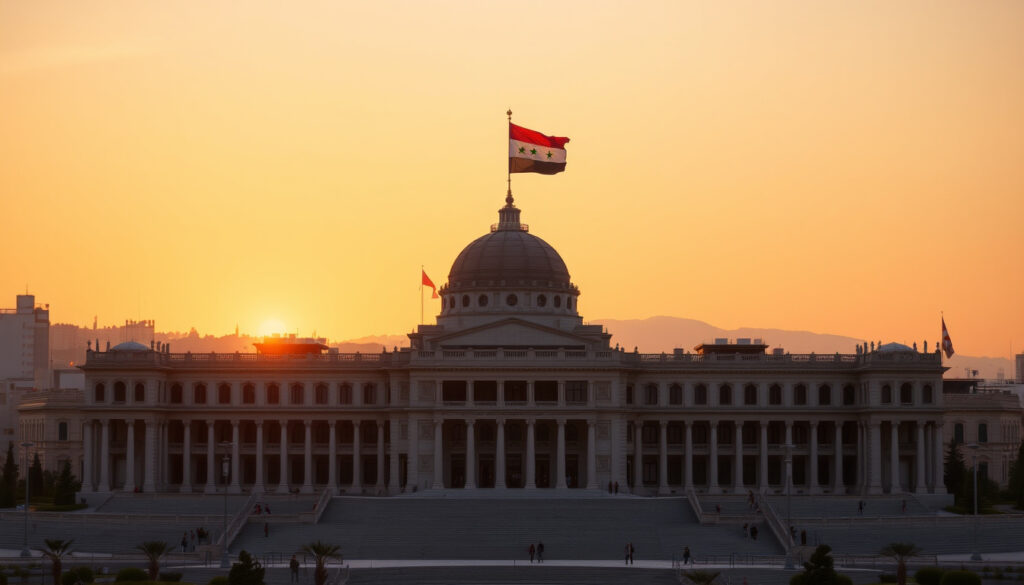
Ahmed al-Sharaa – Rise of Syria’s New President
Ahmed al-Sharaa, formerly known by his nom de guerre Abu Mohammad al-Julani, has become one of the most consequential figures in modern Middle Eastern politics. The leader of Hayat Tahrir al-Sham (HTS) transitioned from commanding rebel forces to serving as Syria’s president since January 2025, following the dramatic overthrow of Bashar al-Assad’s regime in December 2024. His journey from a young militant aligned with al-Qaeda in Iraq to the head of Syria’s interim government represents one of the most remarkable political transformations in recent memory.
Born Ahmed Hussein al-Sharaa in Riyadh, Saudi Arabia, in October 1982, he grew up in Damascus before embarking on a path that would eventually lead him to the highest office in his homeland. The trajectory of his career raises fundamental questions about ideological evolution, political pragmatism, and the possibility of transformation in the context of armed conflict and governance. Understanding who al-Sharaa is—and how he became Syria’s new leader—requires examining multiple facets of his background, affiliations, and recent actions.
Who is Ahmed al-Sharaa?
Ahmed al-Sharaa stands at the center of Syria’s political transformation following decades of civil war and authoritarian rule. As president since January 2025, he oversees a nation rebuilding itself after the fall of a regime that governed for more than five decades. His rise to power came through military leadership of HTS, an organization that evolved from origins closely tied to international jihadist movements into a force capable of toppling an entrenched government.
Ahmed Hussein al-Sharaa
Abu Mohammad al-Julani
President of Syria (since Jan 2025)
Led HTS to overthrow Assad (Dec 2024)
His real identity and nom de guerre
The man now leading Syria was for years known primarily by his battlefield designation. Abu Mohammad al-Julani served as his operational identity while directing forces in Syria’s northwestern Idlib Governorate. The decision to shed this alias and publicly use his birth name marked a deliberate effort to present himself as a statesman rather than a military commander. This transformation in self-presentation coincided with broader shifts in his organizational strategy and political messaging.
Al-Sharaa’s family background connects him to significant historical resistance movements. His name honors a relative who led an uprising against French colonial authorities in the 1920s, according to family tradition that also traces ancestry to the Islamic prophet Muhammad. His father, Hussein al-Sharaa, worked as a petroleum engineer before the family returned to Syria from Saudi Arabia in 1989.
Leadership of HTS
As emir of Hayat Tahrir al-Sham from 2017 to 2025, al-Sharaa built a structure capable of administering territory and delivering services. The organization established the Syrian Salvation Government (SSG), a technocratic civilian administration that managed affairs in areas under HTS control. This governance apparatus provided a foundation for the transition that followed Assad’s fall, allowing al-Sharaa to present himself as experienced in administration rather than solely military operations.
Key insights
- Al-Sharaa successfully rebranded himself from a jihadist commander to a state leader seeking international recognition
- He resisted pressure from Islamic State leader Abu Bakr al-Baghdadi to merge forces, choosing instead to pursue an independent Syrian-focused agenda
- The HTS-controlled administration in Idlib demonstrated capacity for governance, though critics question its human rights record
- Al-Sharaa has offered public assurances to minority communities regarding their rights in post-assad Syria
- Western governments maintain sanctions and designated terror designations that complicate engagement with his government
- His interviews with international media represent a calculated effort to shape perception and build diplomatic legitimacy
Quick facts
| Category | Details |
|---|---|
| Born | October 29, 1982, Riyadh, Saudi Arabia |
| Family origin | Daraa and Golan Heights, Syria |
| Father’s profession | Petroleum engineer |
| Joined al-Qaeda in Iraq | Approximately 2002-2003 |
| Arrested by U.S. forces | May 14, 2005, Mosul |
| Released from custody | March 13, 2011 |
| Established Al-Nusra Front | Early 2012 |
| Formed HTS | 2017 |
| Became president | January 2025 |
What is Ahmed al-Sharaa’s background and rise?
Understanding al-Sharaa’s trajectory requires examining the influences and experiences that shaped his path. His upbringing in Damascus provided exposure to Syrian society and politics, while his later immersion in the Iraqi insurgency following the 2003 U.S. invasion fundamentally altered his trajectory. The combination of these experiences created a figure capable of operating within both militant networks and governance structures.
Early life and jihadist involvement
Al-Sharaa traveled to Iraq shortly before the 2003 American invasion, entering a country descending into chaos. He joined al-Qaeda in Iraq (AQI) and ascended rapidly through organizational ranks, demonstrating capabilities that attracted attention from senior leadership. American forces captured him on May 14, 2005, while he was planting explosives in Mosul, operating under the alias “Amjad Mudhafar.”
His imprisonment spanned more than five years across multiple detention facilities, including the infamous Abu Ghraib prison, Camp Bucca, Camp Cropper, and Camp Taji. During captivity, he displayed adaptability and strategic thinking, convincing Iraqi authorities he was a local resident rather than a foreign fighter by adopting Iraqi-accented Arabic and maintaining his assumed identity. This period of detention ended on March 13, 2011, just days before the Syrian Revolution erupted, positioning him to play a central role in the conflict to come.
Al-Sharaa spent over five years in American and Iraqi custody, a period that coincided with the height of sectarian violence in Iraq. Sources indicate he was released in March 2011, placing him outside Syria during the initial months of the uprising against Bashar al-Assad.
Formation of Al-Nusra Front and the Syrian conflict
Al-Qaeda’s central command, under Ayman al-Zawahiri, designated al-Sharaa to establish the organization’s presence in Syria in August 2011. He created Al-Nusra Front (Jabhat al-Nusra) in early 2012 with explicit support from al-Qaeda’s leadership. Significantly, he recruited young Syrian fighters while keeping his international affiliations concealed, allowing the organization to present itself as a Syrian resistance movement rather than an extension of foreign jihadist networks.
As emir from 2012 to 2017, al-Sharaa directed Al-Nusra Front’s expansion into a formidable military force controlling territory in the northwestern Idlib Governorate. However, his relationship with the Islamic State and its leader Abu Bakr al-Baghdadi became increasingly contentious. When al-Baghdadi attempted to absorb Al-Nusra Front into IS, al-Sharaa refused, triggering open conflict between the groups. This break proved pivotal, as it set al-Sharaa on a path toward organizational independence and eventual rebranding.
Consolidation and governance
Following the split from al-Qaeda in 2016, al-Sharaa renamed the organization Jabhat Fateh al-Sham, a move interpreted by analysts as an effort to avoid international military targeting while refocusing on Syrian objectives. In 2017, he merged multiple rebel factions into Hayat Tahrir al-Sham (HTS), establishing himself as emir and beginning the transformation from militant group to governing authority.
The establishment of the Syrian Salvation Government represented a deliberate attempt to demonstrate administrative capacity. HTS-controlled territory maintained basic services, educational systems, and judicial mechanisms under this parallel administration. While human rights organizations documented concerns about treatment of opponents and civil liberties, the governance structure provided al-Sharaa with practical experience that proved valuable during the transition following Assad’s removal.
What is Ahmed al-Sharaa’s relationship with al-Qaeda?
The evolution of al-Sharaa’s relationship with al-Qaeda remains among the most scrutinized aspects of his biography. His early career demonstrates clear, documented ties to the terrorist organization, while his later actions suggest a significant ideological and organizational shift. However, the completeness and sincerity of this transformation continue to generate debate among governments, analysts, and regional observers.
Historical ties
The historical connection between al-Sharaa and al-Qaeda is well-established through multiple sources. His involvement with al-Qaeda in Iraq preceded his Syrian operations, and he received explicit authorization from al-Qaeda’s central leadership to establish Al-Nusra Front. This was not a grassroots Syrian movement but rather an extension of a transnational organization with documented terrorist operations across multiple countries.
Under his leadership as emir, Al-Nusra Front coordinated with and received support from al-Qaeda’s command structure. The organization’s initial recruitment strategies deliberately obscured these connections from Syrian fighters and the broader public, presenting the group as a Syrian resistance movement while maintaining secret affiliation with international jihadist networks.
Public disavowals and organizational rebranding
Beginning in 2016, al-Sharaa initiated a series of breaks with his previous affiliations. He publicly severed ties with al-Qaeda, changed the organization’s name, and launched internal actions against loyalists to the terrorist network. This rebranding process continued with the formation of HTS in 2017, which positioned itself as a Syrian organization focused on domestic objectives rather than transnational jihad.
In public statements and media interviews, al-Sharaa has renounced transnational jihadism and emphasized commitment to building state institutions within Syria. He has dropped his military alias in favor of his legal name and adopted Western-style dress for public appearances. These communications target both domestic and international audiences, signaling transformation while acknowledging the need for international legitimacy.
Despite al-Sharaa’s public statements distancing himself from al-Qaeda, the group remains designated as a terrorist organization by the United States and numerous other governments. Questions persist about whether former operational ties have been completely severed or whether elements of the previous relationship continue in less visible forms.
Assessing the transformation
Evaluating al-Sharaa’s break from al-Qaeda requires considering multiple factors. His organization no longer operates under al-Qaeda’s banner and has fought against Islamic State forces rather than alongside them. The governance structures established in HTS-controlled territory differ substantially from the caliphate model promoted by al-Qaeda and IS. These concrete developments suggest meaningful organizational differentiation from terrorist predecessors.
However, skeptics point to the tactical nature of rebranding, noting that maintaining previous relationships while publicly disavowing them serves strategic purposes. The depth of ideological transformation—whether al-Sharaa genuinely abandoned jihadist principles or simply adapted his messaging for political advantage—remains genuinely uncertain. This ambiguity complicates international engagement with his government and shapes diplomatic calculations across multiple capitals.
What role did Ahmed al-Sharaa play in Assad’s fall?
The offensive that ended Bashar al-Assad’s fifty-four-year dynastic rule represented the culmination of years of military preparation, political positioning, and coalition building by al-Sharaa and HTS. Beginning in late 2024, this campaign reversed assumptions that the Assad regime had achieved permanent military victory and fundamentally altered Syria’s political landscape within weeks.
HTS offensive in late 2024
Hayat Tahrir al-Sham initiated a coordinated military campaign in late 2024 that caught regional observers and intelligence services by surprise. The offensive demonstrated tactical sophistication, combining conventional military operations with political messaging designed to encourage defections within government-aligned forces. HTS units advanced rapidly from their Idlib strongholds, capturing territory that had remained under government control for years.
The campaign’s success reflected both military capability and strategic exploitation of regional circumstances. Weakened support from traditional allies, internal fractures within government forces, and the movement of refugee populations all contributed to conditions favoring rebel advancement. Al-Sharaa’s role as overall military commander positioned him at the center of decision-making throughout the operation.
Capture of Damascus
HTS forces entered Damascus on December 8, 2024, marking the end of Assad regime control over the Syrian capital. Images from the city showed celebrations as government symbols came down and opposition flags appeared. President Bashar al-Assad fled the country, ending more than five decades of Alawite-family rule that began with his father Hafez in 1970.
Al-Sharaa arrived in Damascus shortly after military confirmation of the capital’s fall, transitioning immediately from military commander to political leader. He declared the end of the old regime and announced arrangements for an interim administration. The speed of this political transformation matched the military campaign’s pace, with al-Sharaa positioning himself as the legitimate successor within days of entering the capital.
Transition to presidential authority
Following the capture of Damascus, al-Sharaa served as Syria’s de facto leader throughout the remainder of December 2024. His formal appointment as president occurred in January 2025, cementing his authority over the transition process. This progression from military commander to head of state occurred more rapidly than many analysts predicted, though preparations for this eventuality had apparently been underway within HTS leadership circles.
The appointment established al-Sharaa as Syria’s president at a moment of extraordinary national challenge. Infrastructure damage, economic collapse, displaced populations, and unresolved tensions with former regime elements all demanded immediate attention. His government’s early statements emphasized stability, reconstruction, and inclusion, though implementing these commitments across Syria’s diverse population presented enormous difficulties.
HTS launched its offensive in late 2024, captured Damascus on December 8, and al-Sharaa subsequently transitioned from military commander to de facto leader. His formal presidential appointment came in January 2025.
What are Ahmed al-Sharaa’s plans for Syria?
Since assuming presidential authority, al-Sharaa has articulated a vision for Syria centered on reconstruction, national reconciliation, and institution building. These stated intentions face the enormous challenge of implementation across a country exhausted by more than a decade of civil war, with millions displaced both internally and abroad. The gap between stated commitments and concrete policy remains a critical area for observation and analysis.
Transition government statements
Public statements from the presidential office emphasize continuity of essential services, security stabilization, and preparation for eventual elections. Al-Sharaa has repeatedly promised inclusive governance that respects the rights of all Syrian communities, including minorities that expressed concern about potential revenge actions following the regime’s fall. These messages target both domestic audiences seeking reassurance and international partners whose recognition and assistance Syria requires.
The Syrian Salvation Government model from Idlib provides some indication of administrative approaches, though scaled implementation across the entire country presents qualitatively different challenges. Emphasis on technocratic governance and decentralized authority appears in official communications, potentially reflecting lessons from both the previous regime’s centralized control and the practical limitations HTS experienced managing its own territory.
International relations stance
Internationally, al-Sharaa’s government faces immediate challenges regarding recognition and diplomatic engagement. The United States maintains terrorist designations affecting HTS and its leadership, complicating official contact despite practical necessity of dealing with the new Syrian authorities. Other governments weigh humanitarian considerations, concerns about the previous affiliations of new leaders, and strategic interests in Syrian stability.
Regional relations require careful management, particularly regarding neighboring countries with direct interests in Syrian developments. Turkey, which supported certain opposition groups, Israel, which has conducted operations in Syrian territory, and Iran, which lost its forward positioned assets with Assad’s fall, all represent factors requiring diplomatic engagement. The statements emphasizing non-transnational jihadism and state building serve partially to reassure these external actors about Syrian intentions.
Challenges and uncertainties
Multiple factors could disrupt stated plans for peaceful transition and reconstruction. Former regime elements retain capabilities and grievances that could manifest in resistance or sabotage. Economic collapse means that even basic government functions require external assistance, creating dependencies that constrain policy autonomy. Sectarian tensions, always present beneath Syrian political surfaces, could reemerge as competing groups seek advantage in the post-assad distribution of power.
The experience of other transitions from armed conflict to governance suggests that stated intentions and actual outcomes frequently diverge. Al-Sharaa’s personal transformation from military commander to head of state requires navigation of institutional requirements, legitimacy demands, and the practical necessities of maintaining control while building durable governing structures. His success or failure in this endeavor will determine whether Syria enters a period of reconstruction or descends into renewed instability.
Timeline: Key moments in Ahmed al-Sharaa’s career
The trajectory from a young man traveling to Iraq before the 2003 invasion to president of Syria encompasses numerous pivotal moments that shaped his development and positioned him for his current role. Understanding this progression illuminates both the individual and the broader forces that transformed Syrian politics.
- 1982: Born in Riyadh, Saudi Arabia, to a Syrian family originally from Daraa and the Golan Heights
- 1989: Family returns to Syria, settling in Damascus
- 2002-2003: Travels to Iraq and joins al-Qaeda in Iraq shortly before U.S. invasion
- May 14, 2005: Arrested by American forces in Mosul while planting explosives
- 2005-2011: Imprisoned in various detention facilities including Abu Ghraib
- March 13, 2011: Released from custody days before Syrian Revolution begins
- August 2011: Tasked by al-Qaeda leadership to establish operations in Syria
- Early 2012: Creates Al-Nusra Front with al-Qaeda support
- 2012-2017: Serves as emir of Al-Nusra Front, builds Idlib stronghold
- 2014-2016: Opposes ISIS merger attempts, leads fighting against Islamic State
- 2016: Severs ties with al-Qaeda, renames organization Jabhat Fateh al-Sham
- January 2017: Establishes HTS through merger of multiple rebel factions
- 2017-2024: Leads HTS and Syrian Salvation Government in Idlib administration
- Late 2024: Directs HTS offensive that collapses Assad regime
- December 8, 2024: HTS forces capture Damascus, al-Sharaa becomes de facto leader
- January 2025: Formally appointed President of Syria
What is established versus what remains uncertain
When examining al-Sharaa’s biography and current role, distinguishing between verified information and genuine uncertainty helps frame appropriate analysis and expectations. Certain facts rest on solid documentation and multiple corroborating sources, while other aspects remain genuinely contested or unknown.
Established information
- Born in 1982 in Riyadh, Saudi Arabia, to Syrian parents
- Joined al-Qaeda in Iraq before 2003 U.S. invasion
- Arrested by American forces in 2005 and imprisoned until 2011
- Established Al-Nusra Front in 2012 under al-Qaeda direction
- Led Al-Nusra Front and then HTS as emir from 2012 to 2025
- Broke organizational ties with al-Qaeda in 2016
- Led HTS forces that captured Damascus in December 2024
- Appointed President of Syria in January 2025
- Changed public identity from Abu Mohammad al-Julani to Ahmed al-Sharaa
Information that remains unclear
- Complete extent of ideological transformation versus tactical repositioning
- Whether all operational ties with former al-Qaeda associates have been severed
- Specific plans for governance structures and political transition timeline
- How former regime elements and minorities will actually be treated in practice
- Degree of control al-Sharaa maintains over all HTS-affiliated fighters
- Long-term sustainability of his government given economic and security challenges
- Whether remaining documentation discrepancies indicate deliberate deception or simple error
Broader context and implications
Al-Sharaa’s rise cannot be understood apart from the larger trajectory of the Syrian conflict and its regional implications. The civil war that began in 2011 killed hundreds of thousands, displaced millions, and drew intervention from numerous external powers. His movement’s victory represents both the culmination of one resistance strategy and a potentially new phase with uncertain outcomes for Syria and the wider region.
The case raises broader questions about leadership transformation, the possibility of former militants successfully transitioning to governance, and the international community’s appropriate response to such developments. Whether al-Sharaa represents genuine ideological evolution or merely sophisticated adaptation for strategic advantage remains perhaps the central question surrounding his presidency. Readers interested in related discussions on political transitions may find additional context valuable for understanding these dynamics.
Regional dynamics have shifted dramatically with Assad’s fall. Iran lost a key ally and its “land bridge” to Hezbollah in Lebanon, affecting security calculations across the Middle East. Turkey, which hosted Syrian refugees and supported certain opposition elements, gains new influence in determining Syria’s future orientation. Israel has expressed concern about potential threats from HTS’s former associations while conducting operations to prevent weapons accumulation near its borders.
Sources and perspectives
Reporting on al-Sharaa draws from multiple source categories with varying reliability and potential biases. Encyclopedic sources such as Wikipedia compile information from numerous primary and secondary sources, providing comprehensive timelines subject to ongoing revision. News organizations including BBC, CNN, and Al Jazeera have conducted interviews and reported on developments, offering journalistic perspectives that prioritize recent events.
Academic and policy research provides deeper analysis of organizational evolution and political implications. Intelligence assessments from Western governments inform official designations and policy positions, though such sources typically remain classified and cannot be independently verified. Regional sources, including those from Jewish Virtual Library and New Lines Magazine, offer perspectives sometimes absent from Western-centric coverage.
“Since breaking with al-Qaeda, al-Sharaa has sought international legitimacy by presenting a more moderate image, renouncing transnational jihadism, and focusing on governance in Syria.”
The availability of direct quotes and extended interviews with al-Sharaa himself remains limited compared to coverage of many other national leaders. International media interviews have increased recently as part of his legitimacy-building strategy, but comprehensive documentation of his statements and commitments remains incomplete. This relative scarcity of primary-source material complicates independent assessment of his views and intentions.
Summary
Ahmed al-Sharaa’s journey from born in Riyadh to president of Syria encompasses military command, organizational transformation, and rapid political ascent that few predicted even months before it occurred. His documented history with al-Qaeda in Iraq and Al-Nusra Front represents established fact, while the completeness and sincerity of his subsequent breaks with those organizations remain genuinely contested. As Syria’s new president, he faces immediate challenges of reconstruction, reconciliation, and governance that will test whether his stated commitments to pluralism and stability translate into durable policy. The international community observes with caution, weighing humanitarian imperatives for engagement against concerns about designations and affiliations that have not been lifted. His success or failure will shape not only Syrian futures but also broader understanding of leadership transformation in conflict-affected societies.
Frequently asked questions
Who leads HTS in Syria?
Ahmed al-Sharaa, also known as Abu Mohammad al-Julani, served as emir of Hayat Tahrir al-Sham from 2017 until January 2025. Following his appointment as President of Syria in January 2025, he transitioned from HTS military leadership to head of state.
Has Ahmed al-Sharaa disavowed al-Qaeda?
Al-Sharaa publicly severed organizational ties with al-Qaeda in 2016 and rebranded his forces away from the terrorist network. He has renounced transnational jihadism in media interviews. However, the United States and other governments maintain terrorist designations, and skeptics question whether all ties have been genuinely severed.
Is Ahmed al-Sharaa the new president of Syria?
Yes. Al-Sharaa was formally appointed President of Syria in January 2025, following his role as de facto leader since HTS forces captured Damascus in December 2024. He succeeded Bashar al-Assad, whose family ruled Syria for over five decades.
What is Ahmed al-Sharaa’s real name?
His birth name is Ahmed Hussein al-Sharaa. He operated under the nom de guerre Abu Mohammad al-Julani for many years but has since adopted his legal name in official communications and public appearances as part of his transformation from military commander to political leader.
What role did al-Sharaa play in overthrowing Assad?
As military commander of HTS, al-Sharaa directed the late 2024 offensive that rapidly collapsed Assad regime forces and captured Damascus on December 8, 2024. He then transitioned from rebel commander to Syria’s de facto leader, formalizing his authority with a presidential appointment in January 2025.
Where was Ahmed al-Sharaa born?
Al-Sharaa was born on October 29, 1982, in Riyadh, Saudi Arabia. His family is originally from Daraa and the Golan Heights in Syria and returned to Damascus in 1989. Some conflicting documents have surfaced suggesting alternative origins, but mainstream biographical sources consistently report his Saudi Arabian birth.
What happened to al-Sharaa’s relationship with al-Qaeda over time?
Al-Sharaa initially traveled to Iraq and joined al-Qaeda in Iraq, then was tasked by al-Qaeda central command to establish Al-Nusra Front in Syria in 2011. He subsequently broke with al-Qaeda in 2016, rejecting merger pressure from ISIS and reorganizing his forces under HTS. This transformation from affiliate to independent actor involved public disavowals and organizational rebranding.
What are al-Sharaa’s stated plans for Syria?
Official communications emphasize reconstruction, national reconciliation, inclusive governance respecting minority rights, and institution building. The government has promised elections and technocratic administration. However, translating these stated commitments into implemented policy faces significant challenges given economic collapse, security concerns, and internal divisions within Syrian society.
More related posts
 25 NZD to USD: Current Rate, Conversion Guide & NZD Weakness
 Most Expensive LEGO Set 2025: Death Star 75419 Facts
 Daylight Savings 2025 NZ: Start & End Dates, Sleep, Myths
 Compare Home Insurance NZ 2024: Best Rates & Providers
 Opening a Bank Account in New Zealand: Non-Resident Guide
 All Blacks vs Scotland 2026: how to watch & history
 Medium Rare Steak Temp in Celsius: 52-54°C Guide
 Culture Kings Discount Code – Verified Savings for 2026
