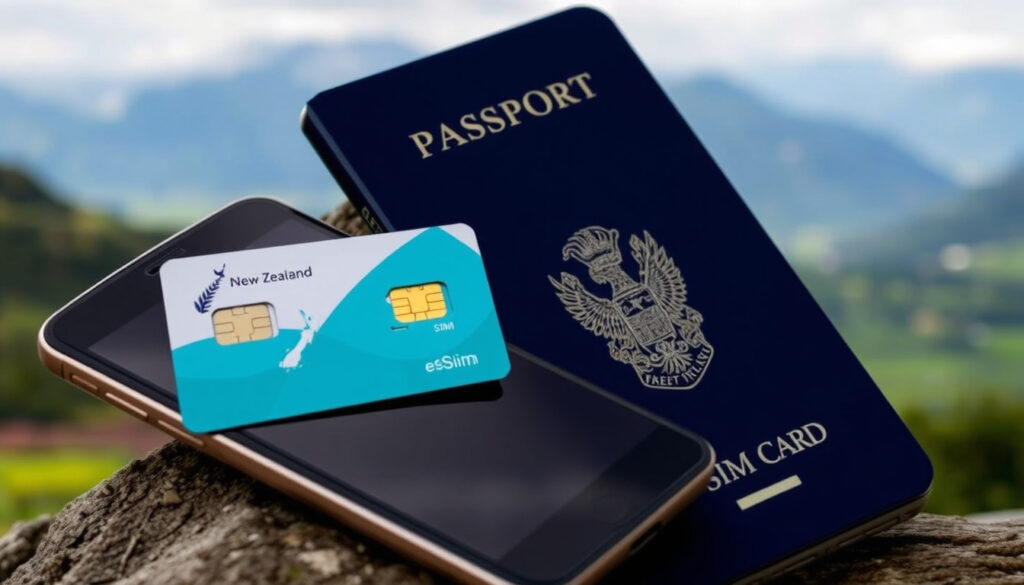
New Zealand SIM Card: Best Prepaid & eSIM Plans
Planning a trip to New Zealand means figuring out how to stay connected, and the answer isn’t as simple as grabbing any SIM card at the airport — with operators like Spark, One NZ, and 2degrees each offering different prepaid packs, your choice depends on where you’re headed and how you use data. This guide cuts through the confusion so you can pick the right SIM for your New Zealand adventure.
Major mobile network operators in New Zealand: Spark, One NZ, 2degrees ·
Estimated cost of a prepaid SIM card: NZD 5–30 for 4–30GB data ·
Top choice for rural coverage: Spark or One NZ ·
Typical validity of travel eSIM: 7–90 days
Quick snapshot
- Spark and One NZ have the best rural coverage (Spark NZ; One NZ)
- SIM cards are available at Auckland, Christchurch, and Wellington airports (eSIM.net)
- Prepaid SIM prices range from NZD 5 to NZD 30 (MoneyHub NZ)
- Exact eSIM pricing for 2degrees travel plans
- Availability of SIM cards at smaller regional airports like Queenstown
- Most recent comparison guides updated as of 2024–2026 (Wise; TravelTomTom)
- eSIM adoption growing; One NZ and Spark now offer data-only eSIMs for travellers (One NZ; Spark NZ)
Four key facts that shape every decision about a New Zealand SIM card for visitors.
| Fact | Detail |
|---|---|
| Three major NZ networks | Spark, One NZ, 2degrees |
| Prepaid SIM price | NZD 5–30 |
| eSIM data-only price | NZD 5–20 |
| Typical 2-week data | 5–10GB |
| Where to buy | Airports, supermarkets, convenience stores (eSIM.net) |
| ID required | Passport recommended at some shops (TravelTomTom) |
What is the best SIM card to get in NZ?
Best SIM card for coverage: Spark or One NZ
- Spark and One NZ operate the most extensive networks, especially outside city centres. If you plan a driving tour of the South Island or a hike in the Tongariro Crossing, these two are your best bet (Spark NZ; One NZ).
- 2degrees is cheaper and works well in urban areas, but its rural coverage is sparser (2degrees).
The implication: for a road trip or mixed itinerary, spend a few extra dollars on Spark or One NZ to avoid losing signal when you need maps most.
Best eSIM for travel: One NZ or Spark data-only eSIM
- One NZ sells an eSIM with data-only packs starting at NZD 5 (One NZ).
- Spark also offers data-only eSIM plans that start from a lower entry price than its full travel SIM (Spark NZ).
- 2degrees’ Unlimited Travel SIM includes unlimited data but is a physical SIM only (2degrees).
The pattern: eSIMs offer immediate activation without hunting for a store, but you usually get less data per dollar than a physical prepaid pack.
Best budget option: Skinny or Warehouse Mobile
- Skinny and Warehouse Mobile are MVNOs running on the Spark network. Their prepaid plans start around NZD 15 for 1+ GB and unlimited texts/calls (MoneyHub NZ).
- These are great if you stay mostly in cities and want the lowest price.
The catch: coverage is identical to Spark, but customer support is online-only.
For most tourists, a Spark or One NZ prepaid SIM (physical or eSIM) is the safest bet. Budget travellers who stick to urban hubs can save with 2degrees or Skinny.
The implication: your itinerary dictates your choice—prioritise coverage if venturing rural, or save money if staying urban.
Can I buy a SIM card at the NZ airport?
SIM cards available at major airports
- Auckland, Christchurch, and Wellington airports all have kiosks from One NZ, Spark, and 2degrees (eSIM.net; TravelTomTom).
- Smaller regional airports like Queenstown may not have dedicated stores — plan ahead.
Airport SIM prices are generally comparable to online or in-store pricing, so there’s no penalty for buying on arrival.
eSIM vs physical SIM at airport kiosks
- Physical SIMs are sold at all major airport stores; you can ask the staff to activate it.
- eSIMs are typically purchased online before you arrive or via QR codes at the kiosk.
Why this matters: if you land late and need data immediately, a physical SIM from the airport lounge is the most reliable option.
Cost of airport SIM cards: NZD 10–30
- A Spark travel SIM starts from NZD 29 with data, calls, and texts (Spark NZ).
- One NZ travel SIM ranges from NZD 5 to NZD 30 (One NZ).
- 2degrees Unlimited Travel SIM is priced similarly, but exact eSIM cost is not publicly listed (2degrees).
Bring your passport — some airport kiosks take a copy at purchase (TravelTomTom).
The pattern: buying at a major airport is straightforward and fairly priced, but plan ahead for regional airports.
How much does a One NZ SIM card cost?
One NZ travel SIM: NZD 5–30
- One NZ sells a travel SIM that includes data, calls, and texts. You can add a $5 unlimited data add-on (One NZ).
- The base SIM costs between NZD 5 and NZD 30 depending on the bundle.
One NZ eSIM: NZD 5–20 (data only)
- One NZ’s eSIM is data-only, making it a lighter option for travellers who rely on WhatsApp and maps (One NZ).
Comparison with Spark and 2degrees pricing
- Spark travel SIM from NZD 29 includes calls, texts, and data (Spark NZ).
- 2degrees Unlimited Travel SIM offers unlimited data but at a higher base cost (exact price not published on the site) (2degrees).
- MoneyHub reports cheap monthly plans from NZD 15 for 1+ GB from other providers (MoneyHub NZ).
Four prepaid options, one clear pattern: data-only eSIMs cost less but give you no local number for calls.
| Provider | Physical SIM price | eSIM price | Data included | Best for |
|---|---|---|---|---|
| One NZ | NZD 5–30 | NZD 5–20 | 1–30GB | Rural coverage, add-on $5 unlimited data |
| Spark | NZD 29+ | Starts lower | Varies | Overall network reach |
| 2degrees | Unlimited Travel SIM | Not listed | Unlimited | Urban travellers who want unlimited data |
| Skinny | NZD 15+ | N/A | 1+ GB | Budget urban use |
The trade-off: One NZ and Spark dominate outside cities, while 2degrees and Skinny win on price if you stay in town.
How much data do you need in New Zealand for travel?
Typical data usage: 2–4 GB per week (light user), 5–10 GB (heavy user)
- Light users (maps, social media, messaging) can manage with 2–4 GB per week (eSIM.net).
- Heavy users (streaming video, video calls) should budget 5–10 GB per week.
Estimates for 2 weeks: 3–10 GB
- For a typical 2-week trip, 5–10 GB covers moderate use. SIMOVO eSIM recommends 4–10 GB for 14 days.
- Wise reports a higher-priced option at NZD 44 for 20 GB with 30-day validity (Wise).
Streaming one hour of HD video uses about 3 GB. If your trip includes Netflix on the road, double your data estimate.
The catch: data needs vary widely by usage, so estimate conservatively and choose a pack that allows topping up.
Is 10 GB of data enough for 2 weeks?
Yes for light to moderate use
- 10 GB is sufficient for maps, social media browsing, messaging, and occasional video clips over 14 days (Wise).
- You can stretch it by using offline maps and connecting to hotel Wi‑Fi.
Heavy users may need 15–20 GB
- If you plan to stream movies daily, join video calls, or upload lots of photos, aim for 15–20 GB.
- 2degrees’ Unlimited Travel SIM removes the worry — unlimited data for the duration (2degrees).
For the majority of visitors, 10 GB is enough. The pattern: choose a pack with at least 5 GB and top up if you run low.
Confirmed facts and what remains unclear
Confirmed facts
- Spark and One NZ have the best rural coverage
- 2degrees is cheaper but limited outside cities
- SIM cards sold at Auckland, Christchurch, Wellington airports
- 10 GB is enough for two weeks of light to moderate use
What’s unclear
- Exact pricing for 2degrees travel eSIM
- Availability of SIM at smaller regional airports like Queenstown
What this means: the key decisions are clear even if some pricing details remain unpublished.
“One NZ sells a travel SIM and eSIM for visitors to New Zealand, with a $5 unlimited data add-on.”
One NZ (official travel SIM page)
“Spark advertises prepaid mobile travel SIMs starting from $29, with data, calls, and texts included.”
Spark NZ (prepaid mobile products)
“2degrees markets an Unlimited Travel SIM that includes unlimited data, calls, and texts to NZ and Australian numbers within New Zealand.”
2degrees (Unlimited Travel SIM)
For anyone wondering whether to know who is calling from a 021 number, having a local SIM with a NZ number makes it easy to check. And once you have your SIM, transferring contacts to your new phone is a simple step to stay organised.
The decision comes down to your itinerary. If you are driving through the South Island or hiking, spend NZD 29 on a Spark travel SIM or NZD 5–30 on One NZ. If you stay in cities and want the lowest price, 2degrees or Skinny will do the job. eSIMs offer convenience but cost more per gigabyte. For the budget-conscious traveller with a well-planned trip, the cheapest option works — but for the adventurer who needs reliable maps in remote spots, the choice is clear: Spark or One NZ, or risk being offline when you need directions most.
petrinadarrah.com, airporttelecom.com, facebook.com, prepaid-data-sim-card.fandom.com, prepaidsims.com.au
Frequently asked questions
What is the best SIM card for New Zealand tourists?
Spark and One NZ are the top choices for coverage, especially outside urban areas. Budget travellers can use 2degrees or Skinny. For convenience, an eSIM from One NZ or Spark activates instantly.
Can I use my existing phone in NZ?
Yes, most unlocked phones work on New Zealand networks. Check that your device supports the bands used by Spark, One NZ, and 2degrees (usually 4G/5G on bands 1, 3, 28).
Is there free Wi‑Fi in New Zealand?
Many cafes, libraries, and hotels offer free Wi‑Fi, but speeds vary. A local SIM is more reliable for navigation and on‑the‑go use.
How do I top up a prepaid SIM in New Zealand?
You can top up online via the operator’s website or app, or buy a voucher at supermarkets, dairies, and service stations.
Do I need ID to buy a SIM card in New Zealand?
There is no legal requirement, but some retailers may ask for a passport as proof of identity when you purchase a prepaid SIM.
What is the difference between eSIM and physical SIM in New Zealand?
An eSIM is a digital SIM you activate online — no plastic card needed. A physical SIM must be inserted into your phone. eSIM plans are often data-only; physical SIMs usually include a local number for calls and texts.
Are SIM cards unlimited in New Zealand?
2degrees offers an Unlimited Travel SIM with unlimited data, calls, and texts. Most other prepaid plans have a data cap, after which speeds are throttled.
Which network has the best coverage in New Zealand?
Spark and One NZ share the most extensive 4G/5G coverage, especially in rural and mountainous regions. 2degrees focuses on urban areas.
More related posts
 South Waikato District Council: Services, Towns & Contacts
 Sol de Janeiro NZ: Where to Buy & What to Know
 Portrait of a Lady on Fire: True Story, LGBTQ+ Themes, Age Rating
 Claire Danes Movies and TV Shows: Complete List and Ratings
 Baradene College of the Sacred Heart Fees and Rankings
 Early Childhood Education NZ: Qualifications, Demand, Costs
 10 Funniest Jokes for Adults: Hilarious One-Liners
