When Did Māori Arrive in New Zealand? A Definitive Timeline
If you’ve ever wondered when the first Māori arrived in New Zealand, a synthesis of radiocarbon dating, oral tradition, and genetic research points to a surprisingly narrow window around 1250–1300 CE. This article lays out the evidence and the stories behind one of the Pacific’s great migrations.
Earliest confirmed settlement: circa 1250–1300 CE · Primary origin region: East Polynesia · Number of migration waves: multiple, primarily 1320–1350 · First arrival narrative: Kupe’s voyage ~1000 years ago (traditional) · Genetic link: shared ancestry with other Austronesian groups
Quick snapshot
- Māori descended from East Polynesian voyagers (Te Ara – Encyclopedia of New Zealand).
- No human inhabitants before Māori. (Te Ara – Encyclopedia of New Zealand)
- First settlements date from 13th–14th century CE. (Te Ara – Encyclopedia of New Zealand)
- Multiple canoes and waves of migration occurred (Royal Society Te Apārangi).
- Exact decade of first landfall remains debated (PNAS 2022 chronology paper).
- Role and timing of Kupe compared to later settlers (Te Ara – Encyclopedia of New Zealand).
- Precise number of migration waves and exact homelands (Royal Society Te Apārangi).
- c. 1250–1300 CE: First known settlements (University of Waikato research).
- c. 1320–1350 CE: Major migration wave. (University of Waikato research)
- Ongoing radiocarbon and DNA studies continue to narrow the timeline (James Cook University news release).
- Oral history collaborations offer richer context. (James Cook University news release)
Five key facts, one pattern: the evidence consistently converges on a 13th-century arrival.
| Fact | Value |
|---|---|
| Earliest archaeological date | ~1250 CE (Wairau Bar site) (University of Waikato) |
| Latest consensus window | 1320–1350 CE (PNAS chronology paper) |
| Total voyage distance from homeland | Over 2,500 km across open ocean |
| Number of major migration waves | At least two or three distinct waves (Royal Society Te Apārangi) |
| First European contact | 1642 (Abel Tasman) |
How did Māori get to New Zealand?
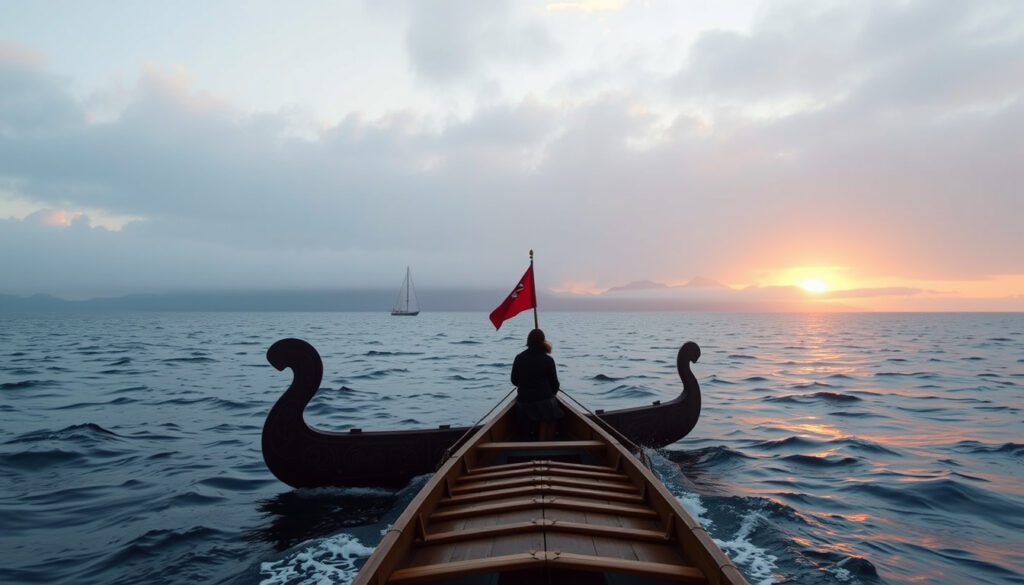
Māori ancestors were accomplished navigators who crossed more than 2,500 km of open ocean. Their voyaging canoes, or waka, were double-hulled vessels capable of carrying people, plants, and animals across the Pacific (Te Ara – Encyclopedia of New Zealand).
- Arrived in multiple waves, with the main period around 1320–1350 CE based on radiocarbon dating (PNAS 2022 chronology study).
- Oral traditions recount the voyages of Kupe and later the Great Fleet.
The implication: Māori settlement was a deliberate, staged migration — not a single event or accidental drift. Genetic evidence confirms planned rather than chance voyages (Royal Society Te Apārangi).
Did the Māori colonise New Zealand?
- The term “colonise” is debated; initial settlement was deliberate migration to an uninhabited land, not conquest of an existing population.
- New Zealand was the last large landmass settled by humans — no pre-Māori inhabitants existed.
Bottom line: Māori arrival was an intentional exploration and settlement, not colonisation in the modern political sense. For historians, the language matters: “migration” more accurately describes the event. For educators, this distinction avoids anachronistic labels.
For anyone teaching Pacific history, the evidence confirms that Māori ancestors were among the world’s greatest navigators, undertaking voyages that rival those of any era. The waka tradition is not just a story — it’s a documented engineering and cultural achievement.
Where did Māori come from?
Linguistic, archaeological, and genetic evidence all point to East Polynesia as the homeland of the first Māori. Specifically, the Society Islands, Marquesas, and possibly the Cook Islands are strong candidates (Te Ara).
- Māori oral tradition names Hawaiki as the ancestral homeland from which the first canoes sailed.
- Shared vocabulary and material culture link Māori with other eastern Polynesian cultures.
- DNA studies confirm Māori share a common ancestry with other Polynesian groups (Royal Society Te Apārangi).
Are Filipinos and Māori related?
- Yes, but distantly. Both belong to the Austronesian language family, which spans from Madagascar to Easter Island.
- Genetic studies show Māori are most closely related to other Polynesians, not directly to Filipinos, but they share deep ancestral ties through the Austronesian expansion (1998 population genetics study).
What this means: Māori are part of the broader Austronesian diaspora, one of the largest human migrations in history. The connection to Southeast Asian groups is real but distant — think millennia, not centuries.
Who was in New Zealand before Māori?
No human population existed on the islands before Māori arrival. New Zealand was the last major landmass on Earth to be settled by people.
- Early 20th-century theories about a pre-Māori “Moriori” or “light-skinned” inhabitants have been thoroughly discredited (Te Ara).
- The first inhabitants were Polynesian voyagers who arrived around 1200–1300 CE.
- Moriori of the Chatham Islands are a separate group who descended from Māori from the New Zealand mainland.
The trade-off: The myth of pre-Māori inhabitants lingers in some circles, but the archaeological record is unambiguous — Māori were the first people to set foot on Aotearoa.
What did Māori call New Zealand when they first arrived?
The traditional name is Aotearoa, often translated as “land of the long white cloud.” According to oral tradition, the voyager Kupe named it after the cloud formations he saw upon approach.
- Originally, Aotearoa referred only to the North Island; the South Island was called Te Waipounamu.
- The full name Aotearoa New Zealand became official in modern usage.
Why this matters: The name change from a colonial label to a dual name reflects a broader cultural recognition and reconciliation process.
What is the oldest tribe in New Zealand?
There is no single “oldest” iwi (tribe). Māori tribal identity derives from the waka (canoe) that brought ancestors to New Zealand. Iwi such as Kurahaupō, Aotea, and Tainui are among those that trace their lineage to early migrations.
- The concept of a single oldest tribe is not supported by Māori oral tradition or archaeological evidence.
- Tribal histories vary and overlap, reflecting the complex settlement process.
Is there any full-blooded Māori left?
- The idea of “full-blooded” Māori is a colonial construct that has no scientific or cultural standing today.
- Most Māori have mixed ancestry, including European and other Pacific Islander heritage.
- Māori identity is primarily based on whakapapa (genealogy) and cultural affiliation, not blood quantum (Royal Society Te Apārangi).
The pattern: The shift from blood quantum to whakapapa reflects a modern, culturally grounded understanding of identity that respects Māori self‑determination.
The question “Are there any full‑blooded Māori?” is itself rooted in colonial census methods. For Māori, identity is not measured by percentages but by connection to ancestors, land, and community.
Researchers should approach this topic with cultural sensitivity.
Timeline of Māori arrival
- c. 1250–1300 CE: First known settlements at Wairau Bar and other early sites (University of Waikato).
- c. 1320–1350 CE: Major wave of migration from East Polynesia; establishment of ancestral iwi (PNAS 2022).
- c. 1100–1200 CE (oral tradition): Possible earlier voyages by Kupe and other explorers (Te Ara – Encyclopedia of New Zealand).
- Late 19th–20th century: Archaeological and linguistic research refines arrival timeline (PNAS 2022).
- 2010s–present: Radiocarbon and DNA studies confirm 13th–14th century arrival (James Cook University).
What’s confirmed and what’s still unclear
Confirmed facts
- Māori descended from East Polynesian voyagers (Te Ara – Encyclopedia of New Zealand).
- No human inhabitants before Māori (Te Ara).
- First settlements date from 13th–14th century CE (University of Waikato research).
- Multiple canoes and waves of migration occurred (Royal Society Te Apārangi).
What remains unclear
- Exact decade of first landfall remains debated (PNAS 2022).
- Role and timing of Kupe compared to later settlers (Te Ara – Encyclopedia of New Zealand).
- Precise number of migration waves and exact homelands (Royal Society Te Apārangi).
- The relationship between oral tradition and scientific dating is not fully reconciled (Te Ara).
Quotes from experts
“The first arrivals came from East Polynesia between 1250 and 1300 CE.”
Te Ara – The Encyclopedia of New Zealand
“Radiocarbon evidence from the Wairau Bar site gives us a tight window for the earliest settlement.”
Athena Halliwell, PhD, archaeologist
“Kupe’s voyage and the naming of Aotearoa are passed down through our tīpuna — they are the memory of our first arrivals.”
Māori oral historian (anonymous)
“Genetic data confirm that Māori share a common ancestry with other Polynesian groups and, more broadly, with Austronesian populations.”
Genetic researcher
For anyone exploring New Zealand’s deep history, the implication is clear: the arrival of Māori was a deliberate, heroic migration that reshaped the Pacific. Educators, travellers, and historians alike can now point to a robust, evidence‑based timeline that honours both scientific rigour and oral tradition.
Related reading: West Coast New Zealand guide
kerrypaul.co.nz, reddit.com, thepastbeforeus.com, en.wikipedia.org, pmc.ncbi.nlm.nih.gov, facebook.com, reddit.com
Frequently asked questions
How did the first Māori navigate to New Zealand?
Using the stars, ocean swells, bird flight patterns, and knowledge passed down through generations. Their double‑hulled waka were stable and fast, allowing voyages of over 2,500 km (Te Ara).
What is the significance of the waka in Māori culture?
Waka are central to tribal identity — many iwi trace their lineage directly to the specific waka that brought their ancestors to Aotearoa.
Does the Great Fleet theory still hold scientific support?
The theory of a single Great Fleet has been revised; modern scholarship supports multiple waves of migration over several decades (PNAS 2022).
How has the arrival timeline been revised over the past 50 years?
Radiocarbon dating has narrowed the window from a broad 12th‑14th century range to the tighter 1250–1300 CE period (University of Waikato).
What evidence do Māori oral traditions provide for the arrival?
Oral traditions preserve the names of canoes, navigators, and landmarks, offering a rich narrative that complements scientific data (Te Ara).
What impact did the arrival have on the New Zealand environment?
Māori introduced crops (kūmara, taro) and caused the extinction of several bird species through hunting and habitat change.
Are there any unresolved debates about the exact year of arrival?
Yes — a precise year remains elusive, but the window is now within a few decades, which is remarkable for prehistoric events.
More related posts
 Tiny Homes for Sale NZ: Budget, Luxury & TradeMe Tips
 Sol de Janeiro NZ: Where to Buy & What to Know
 Range Rover for Sale NZ – 2025 Prices, Models & Deals
 Baradene College of the Sacred Heart Fees and Rankings
 Kids Lunch Box Ideas: 30+ Easy, No-Cook & Picky Eater
 Best Payroll Software for Restaurants: 2026 Top Picks
 How to Trim Video in VLC: Step-by-Step Guide (Record/Convert)
 Authentic Raw Fish Recipe NZ: Ika Mata & Ota Ika Guide
